
Most people go through their day reacting instead of leading. Stoic quotes on purpose exist to break that cycle. The Stoics — Marcus Aurelius, Seneca, and Epictetus — were not abstract thinkers. They were an emperor, a statesman, and a former slave, and each faced real loss, pressure, and uncertainty. Their words on purpose still hold up because they were tested in real life, not written in a classroom.
This guide brings together 125+ Stoic quotes on purpose, organized by philosopher, along with a clear explanation of what Stoic purpose actually means and how to build it into daily life. No filler — just the quotes, the philosophy behind them, and how to use them.
Table of Contents
What Is Stoic Purpose? Understanding the Philosophy Behind the Quotes
Stoic purpose isn’t a goal you chase or a job title you earn. It’s a way of directing your actions toward what’s within your control, guided by virtue and reason. The Stoics called this living “in accordance with nature” — meaning your own rational nature, not luck, status, or outcomes you can’t control.
Three ideas hold this philosophy together. The dichotomy of control separates what you can influence (your choices, effort, judgment) from what you can’t (other people, results, timing). Duty, or kathēkon, is the idea that every person has a role to play, much like an actor cast in a part. And amor fati — the acceptance of fate — means working with your circumstances instead of resenting them.
Put simply: Stoic purpose is direction, not a destination. Marcus Aurelius wrote it as duty. Seneca framed it as knowing your “port.” Epictetus called it playing your role well. Different words, same idea.
Powerful Stoic Quotes on Purpose
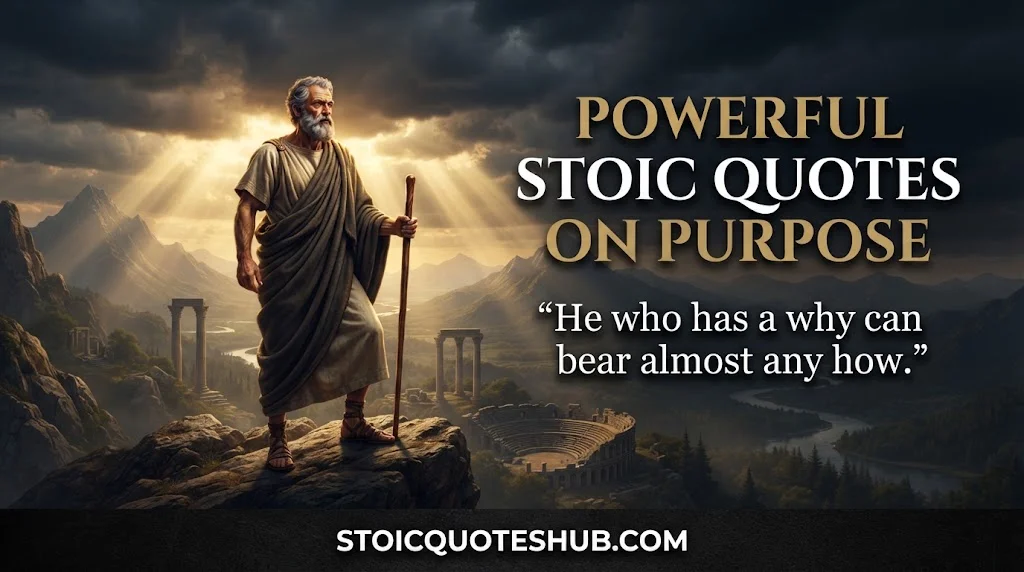
Below are quotes organized by philosopher. Each one reflects a different angle on purpose — duty, direction, action, and role.
Marcus Aurelius Quotes on Purpose
As Roman emperor, Marcus Aurelius wrote Meditations as private notes to himself, not for publication. That’s part of why these lines feel so direct.
- “Waste no more time arguing about what a good man should be. Be one.”
- “You have power over your mind — not outside events. Realize this, and you will find strength.”
- “The happiness of your life depends upon the quality of your thoughts.”
- “It is not death that a man should fear, but he should fear never beginning to live.”
- “Everything we hear is an opinion, not a fact. Everything we see is a perspective, not the truth.”
- “The impediment to action advances action. What stands in the way becomes the way.”
- “Confine yourself to the present.”
- “If it is not right, do not do it; if it is not true, do not say it.”
- “Very little is needed to make a happy life; it is all within yourself, in your way of thinking.”
- “He who lives in harmony with himself lives in harmony with the universe.”
- “Do every act of your life as though it were the very last act of your life.”
- “At dawn, when you have trouble getting out of bed, tell yourself: I have to go to work — as a human being.”
- “Dwell on the beauty of life. Watch the stars, and see yourself running with them.”
- “The best revenge is to be unlike him who performed the injury.”
- “Never let the future disturb you. You will meet it, if you have to, with the same weapons of reason which today arm you against the present.”
- “Accept the things to which fate binds you, and love the people with whom fate brings you together.”
- “How much trouble he avoids who does not look to see what his neighbor says or does.”
- “Loss is nothing else but change, and change is nature’s delight.”
- “What we do now echoes in eternity.”
- “You could leave life right now. Let that determine what you do and say and think.”
- “Because a thing seems difficult for you, do not think it impossible.”
- “Our life is what our thoughts make it.”
- “First say to yourself what you would be; and then do what you have to do.”
- “Everything — a horse, a vine — is created for some duty. For what task, then, were you yourself created?”
- “Just as nature takes every obstacle and works around it, so too a rational being can turn each setback into raw material and use it to achieve its goal.”
- “If you seek tranquility, do less. Or, more accurately, do what’s essential.”
- “The art of living is more like wrestling than dancing.”
- “Do not act as if you were going to live ten thousand years. Death hangs over you. While you live, while it is in your power, be good.”
- “Concentrate every minute like a Roman — on doing what’s in front of you with precise and genuine seriousness.”
- “Adapt yourself to the things among which your lot has been cast, and love sincerely the fellow creatures with whom destiny has ordained that you shall live.”
- “Remember that man lives only in the present, in this fleeting instant.”
- “The universe is change; life is opinion.”
- “Nowhere can man find a quieter or more untroubled retreat than in his own soul.”
- “Think of yourself as dead. You have lived your life. Now take what’s left and live it properly.”
- “Reject your sense of injury and the injury itself disappears.”
- “Be like the rocky headland on which the waves constantly break.”
- “When you arise in the morning, think of what a precious privilege it is to be alive — to breathe, to think, to enjoy, to love.”
- “Kindness is invincible, but only when it’s sincere.”
- “Take away your opinion, and then there is taken away the complaint.”
- “The object of life is not to be on the side of the majority, but to escape finding oneself in the ranks of the insane.”
- “No longer talk at all about the kind of man that a good man ought to be, but be such.”
- “Everything is here for a purpose, from horses to vine shoots.”
- “Poverty of spirit is having no purpose, so a man ought to have some object, either speculative or practical, in view.”
- “Nothing happens to anybody which he is not fitted by nature to bear.”
- “A man’s true greatness lies in the consciousness of an honest purpose in life.”
Seneca Quotes on Purpose
Seneca served as advisor to Emperor Nero and wrote extensively on direction, time, and how to live with intention despite political danger.
- “If a man knows not to which port he sails, no wind is favorable.”
- “It is not that we have a short time to live, but that we waste a lot of it.”
- “Difficulty strengthens the mind, as labor does the body.”
- “The whole future lies in uncertainty: live immediately.”
- “Every new beginning comes from some other beginning’s end.”
- “Life is long if you know how to use it.”
- “Man’s ideal state is realized when he has fulfilled the purpose for which he is born.”
- “We suffer more often in imagination than in reality.”
- “It is not the man who has too little, but the man who craves more, that is poor.”
- “True happiness is to enjoy the present, without anxious dependence upon the future.”
- “As is a tale, so is life: not how long it is, but how good it is, is what matters.”
- “Begin at once to live, and count each separate day as a separate life.”
- “He who is brave is free.”
- “Sometimes even to live is an act of courage.”
- “The mind that is anxious about future events is miserable.”
- “Putting things off is the biggest waste of life.”
- “Luck is what happens when preparation meets opportunity.”
- “No man was ever wise by chance.”
- “A gem cannot be polished without friction, nor a man perfected without trials.”
- “Wherever there is a human being, there is an opportunity for kindness.”
- “Silence is a lesson learned through life’s many sufferings.”
- “It is the power of the mind to be unconquerable.”
- “While we wait for life, life passes.”
- “The day which we fear as our last is but the birthday of eternity.”
- “You act like mortals in all that you fear, and like immortals in all that you desire.”
- “We are more often frightened than hurt, and we suffer more in imagination than in reality.”
- “He suffers more than necessary, who suffers before it is necessary.”
- “The special characteristic of a great man is to triumph over the disasters and panics of human life.”
- “Study as though you were to live forever; live as though you were to die tomorrow.”
- “Retire into yourself as much as you can.”
- “Set aside a certain number of days during which you shall be content with the scantiest and cheapest fare.”
- “The greatest obstacle to living is expectancy, which hangs upon tomorrow and loses today.”
- “Every man prefers belief to the exercise of judgment.”
- “Life, if well lived, is long enough.”
- “The best ideas are common property.”
- “To wish to be well is a part of becoming well.”
- “He who has learned to die has unlearned slavery.”
- “Man’s ideal state is realized when he has fulfilled the purpose for which he is born. And what is it that reason demands of him? Something very easy — that he live in accordance with his own nature.”
- “We all sorely complain of the shortness of time, and yet have much more than we know what to do with.”
- “Our plans miscarry because they have no aim. When a man does not know what harbor he is making for, no wind is the right wind.”
Must Visit: 140+ Powerful Stoic Mindset Quotes to Transform Your Life & Build Inner Strength
Epictetus Quotes on Purpose
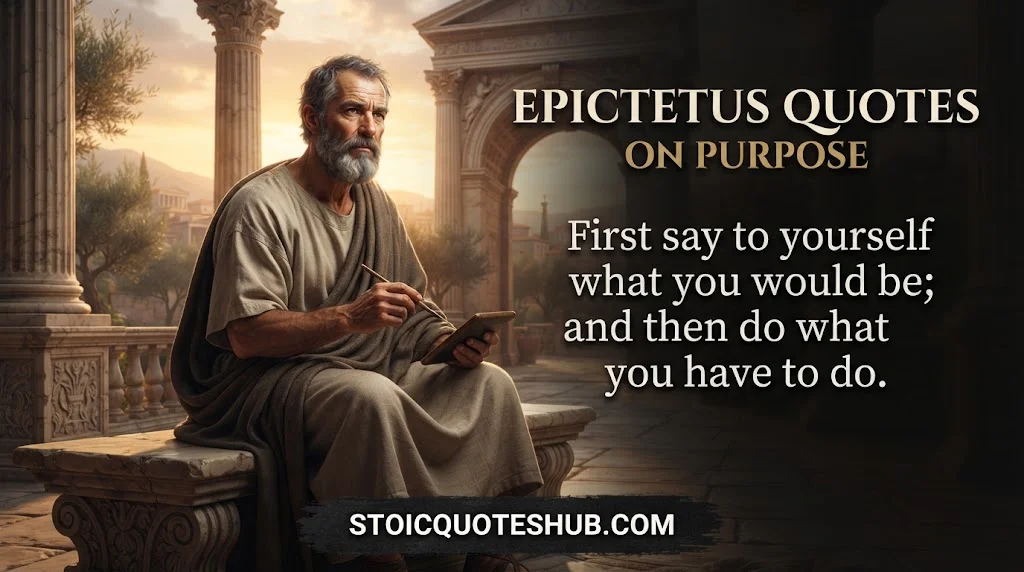
Born into slavery, Epictetus later taught philosophy focused almost entirely on what’s actually in your control — a theme central to purpose.
- “It’s not what happens to you, but how you react to it that matters.”
- “No man is free who is not master of himself.”
- “Man is disturbed not by things, but by the views he takes of them.”
- “First say to yourself what you would be; and then do what you have to do.”
- “Only the educated are free.”
- “He is a wise man who does not grieve for the things which he has not, but rejoices for those which he has.”
- “Freedom is the only worthy goal in life. It is won by disregarding things that lie beyond our control.”
- “Don’t explain your philosophy. Embody it.”
- “We have two ears and one mouth so that we can listen twice as much as we speak.”
- “It is impossible for a man to learn what he thinks he already knows.”
- “Wealth consists not in having great possessions, but in having few wants.”
- “He who hesitates is lost.”
- “The key is to keep company only with people who uplift you, whose presence calls forth your best.”
- “Circumstances don’t make the man, they only reveal him to himself.”
- “Make the best use of what is in your power, and take the rest as it happens.”
- “If you want to improve, be content to be thought foolish and stupid.”
- “There is only one way to happiness — cease worrying about things which are beyond the power of our will.”
- “You become what you give your attention to.”
- “Focus not on what he or she does, but on keeping to your higher purpose.”
- “In trying to please other people, we find ourselves misdirected toward what lies outside our sphere of influence.”
- “Getting distracted by trifles is the easiest thing in the world. Focus on your main duty.”
- “He who is discontented with what he has, would not be content with what he would like to have.”
- “Remember that you are an actor in a play, which is as the author wants it to be.”
- “Don’t demand or expect that events happen as you would wish them to.”
- “Difficulties are things that show a person what they are.”
- “Any person capable of angering you becomes your master.”
- “People are disturbed not by things, but by the principles and notions which they form concerning things.”
- “We do not choose our own parts in life. Our duty is confined to playing them well.”
- “The fruit of these teachings is tranquility, fearlessness, and freedom.”
- “No great thing is created suddenly.”
- “Seek not that the things which happen should happen as you wish; but wish the things which happen to be as they are, and you will have a tranquil flow of life.”
- “To accuse others for one’s own misfortunes is a sign of want of education.”
- “When something happens, the only thing in your power is your attitude toward it.”
- “Try to enjoy the great festival of life with other men.”
- “There is only one thing for which I was sent into the world — to develop every kind of virtue.”
More Stoic-Inspired Voices on Purpose
These figures either shaped early Stoicism or drew heavily from it in their own work on meaning and direction.
- “Happiness is a good flow of life.” — Zeno of Citium
- “Man conquers the world by conquering himself.” — Zeno of Citium
- “Lead me, Zeus, and you, Destiny, wherever you have assigned me.” — Cleanthes
- “It is not the specific form of work that matters, but that we do it well.” — Musonius Rufus
- “If someone accomplishes some good though laboring long, the labor passes, but the good remains.” — Musonius Rufus
- “He who has a why to live can bear almost any how.” — Friedrich Nietzsche
- “What man actually needs is not a tensionless state but rather the striving and struggling for some goal worthy of him.” — Viktor Frankl
- “The life given us, by nature, is short; but the memory of a well-spent life is eternal.” — Cicero
How Stoic Quotes on Purpose Can Transform Your Mindset
Reading a quote doesn’t change you. Understanding the mechanism behind it does. Stoic purpose works because it shifts your sense of self-worth away from outcomes — which you can’t control — and toward effort and judgment, which you can.
This isn’t just philosophy. Research on purpose in life backs it up. A study published in the journal Preventive Medicine, using data from over 13,000 U.S. adults age 50 and older, found that people with the strongest sense of purpose had roughly a 15% risk of death from any cause, compared to about 36.5% for those with the weakest sense of purpose, according to findings reported by Medical News Today. The link held even after adjusting for income, physical health, and mental health.
That’s the modern evidence for something the Stoics argued 2,000 years ago: a clear sense of direction doesn’t just feel better — it changes how you handle stress, setbacks, and daily friction. When your goal is “act with virtue” instead of “get this specific result,” failure stops being catastrophic. You judge yourself by effort, not chance.
How to Live Your Stoic Purpose Every Day
Insight fades fast without practice. These are simple, repeatable habits drawn directly from Stoic method.
Morning role-check. Before the day starts, ask: what role am I playing today, and what would it mean to play it well? This mirrors Epictetus’s actor metaphor.
Dichotomy-of-control filter. When something frustrates you, sort it into two columns — what you control (your response) and what you don’t (everything else). Only act on the first column.
Evening review. Seneca reportedly reviewed his day each night, asking what he did well, what he did poorly, and what he’d change. Five minutes is enough.
One duty, done fully. Instead of chasing ten goals, pick one task tied to your purpose and give it full attention. Marcus Aurelius repeatedly returned to “do what’s essential.”
Negative visualization. Briefly imagine losing something you value. This isn’t pessimism — it builds gratitude and reduces anxious attachment to outcomes.
None of these require special tools. They’re daily, five-minute habits that turn a Stoic mindset from an idea into a routine.
FAQs
What are the best Stoic quotes on purpose?
Some of the most cited include Marcus Aurelius’s “Waste no more time arguing about what a good man should be. Be one,” Seneca’s “If a man knows not to which port he sails, no wind is favorable,” and Epictetus’s “First say to yourself what you would be; and then do what you have to do.” Each reflects the same core idea from a different angle: purpose is action, not talk.
What do Stoics say about finding your purpose in life?
Stoics argue purpose isn’t found through searching — it’s built through living in accordance with reason and virtue. Epictetus compared it to playing an assigned role well, regardless of whether the role is grand or small.
How can Stoic quotes help you discover your purpose?
They reframe purpose as something within your control. Instead of asking “what will make me successful,” Stoic quotes push you to ask “what would it mean to act with integrity right now?” That shift removes the pressure of chasing an external outcome.
What is the Stoic philosophy of purpose?
It centers on the dichotomy of control, duty (kathēkon), and living according to nature. Purpose is defined by consistent, virtuous action — not by titles, wealth, or approval from others.
How do Stoics define a meaningful life?
A meaningful life, in Stoic terms, is one lived with reason, virtue, and acceptance of what can’t be changed. Seneca put it simply: life’s length matters less than how well it’s lived.
Conclusion
Purpose in the Stoic sense, was never about finding one perfect calling. It’s about showing up daily with reason and intention, regardless of circumstance. Marcus Aurelius, Seneca, and Epictetus each lived through real hardship, and their words on purpose survived because they were tested, not theoretical. Use these quotes as a starting point then let the daily practice do the actual work.

Danish Abroy is a writer and contributor at Stoic Quotes Hub, where he explores timeless ideas from Stoic philosophy and their relevance to modern life. His work focuses on meaningful quotes, practical wisdom, resilience, self-discipline, and developing a calmer perspective in everyday situations.