Marcus Aurelius ruled Rome for nearly two decades, yet his most lasting legacy isn’t a law or a battle. It’s a private notebook. Inside, you’ll find some of the most powerful Marcus Aurelius Stoic quotes ever written — words that still calm anxious minds today, nearly 1,900 years later.
This guide collects the best Marcus Aurelius quotes on the mind, strength, death, and purpose, with plain-language takeaways you can actually use.
Table of Contents
Who Was Marcus Aurelius? (Context Every List Skips)
Marcus Aurelius ruled the Roman Empire from 161 to 180 CE. Historians call him one of the Five Good Emperors, and many still call him the Philosopher King.
He wasn’t writing for readers. He kept a private journal, now known as Meditations, to work through his own fears, frustrations, and duties. He never meant to publish it.
Marcus studied under several teachers, including the Stoic philosopher Junius Rusticus, who introduced him to the writings of Epictetus. That exposure shaped almost everything in his notebook. Stoicism taught him that a person can’t control outside events — only their own judgments and reactions.
Here’s a detail most quote roundups skip: Meditations almost vanished from history. Marcus died in 180 CE, and his notebook disappeared for centuries. The historian Herodian first mentioned it in the mid-200s. The earliest confirmed reference comes from a Byzantine bishop named Arethas of Caesarea, around 900 CE. The oldest surviving copy, the Codex Vaticanus, wasn’t printed until 1558. Today, the most-read English versions come from translators Gregory Hays, Martin Hammond, George Long, and Robin Hard — and their wording differs, sometimes a lot, for the same passage.
That history matters. It’s part of why these quotes carry weight: they weren’t written for applause. They were written by a man testing his own philosophy against real pressure — plague, war, grief, and the daily grind of running an empire.
Marcus Aurelius Quotes on the Mind & Self-Control
Marcus returned to one idea again and again: your mind is the one thing you fully control. Everything else — other people, weather, luck, even your own body — sits outside your grip.
“You have power over your mind — not outside events. Realize this, and you will find strength.” — Meditations 7.2
This single line is probably the most quoted sentence Marcus ever wrote. It sounds simple, but it’s a full worldview. Pain, insult, and bad news only hurt you once you add a judgment to them. Strip the judgment away, and the sting often goes with it.
“Remove the judgement, and you have removed the thought ‘I am hurt’: remove the thought ‘I am hurt,’ and the hurt itself is removed.” — Meditations 4.7 (Hammond translation)
“Your mind will take on the character of your most frequent thoughts: souls are dyed by thoughts. So dye your own.” — Meditations 5.16
Modern psychology backs this up more than people expect. Cognitive reframing, a core tool in cognitive behavioral therapy, rests on almost the exact same premise Marcus described nearly two millennia earlier: change the interpretation, and you change the emotional response.
“Choose not to be harmed — and you won’t feel harmed. Don’t feel harmed — and you haven’t been.” — Meditations 4.7 (Hays translation)
“Everything we hear is an opinion, not a fact. Everything we see is a perspective, not the truth.”
These lines push back against a habit most people never question: treating a first impression as a settled fact. Marcus asks you to pause and separate the event from your story about the event.
Marcus Aurelius Quotes on Strength & Resilience
One of the most famous ideas in Stoic philosophy — sometimes labeled “the obstacle is the way” — comes straight from Marcus’s notebook.
“The impediment to action advances action. What stands in the way becomes the way.” — Meditations 5.20
Marcus wrote this while managing the Marcomannic Wars, years of brutal fighting along the Danube. He wasn’t offering theory. He was talking himself through real hardship, page by page. His point: a blocked path can reveal a better one, and setbacks often build the exact strength you’ll need later.
He also believed real strength comes from doing less, but doing it well.
“If you seek tranquility, do less. Or, more accurately, do what’s essential.” — Meditations 4.24
“Ask yourself at every moment, ‘Is this necessary?'” — Meditations 4.24
This isn’t laziness. It’s focus. Marcus argued that most talk and most action is unnecessary noise, and cutting it out frees up energy for what truly matters — a strikingly modern idea about burnout and mental clarity.
“You must compose your life action by action, and be satisfied if each action achieves its own end as best it can.” — Meditations 8.32
“No, you do not have thousands of years to live. Urgency is on you. While you live, while you can, become good.” — Meditations 4.17
“Because a thing seems difficult for you, do not think it impossible.”
Marcus also listed virtues he believed anyone could practice, regardless of talent: integrity, dignity, hard work, self-denial, contentment, frugality, kindness, and simplicity. His point was blunt — you don’t need special skill to be strong. You need discipline.
Must Visit: 125+ Powerful Stoic Quotes on Purpose to Transform Your Life & Mindset
Marcus Aurelius Quotes on Death & Mortality
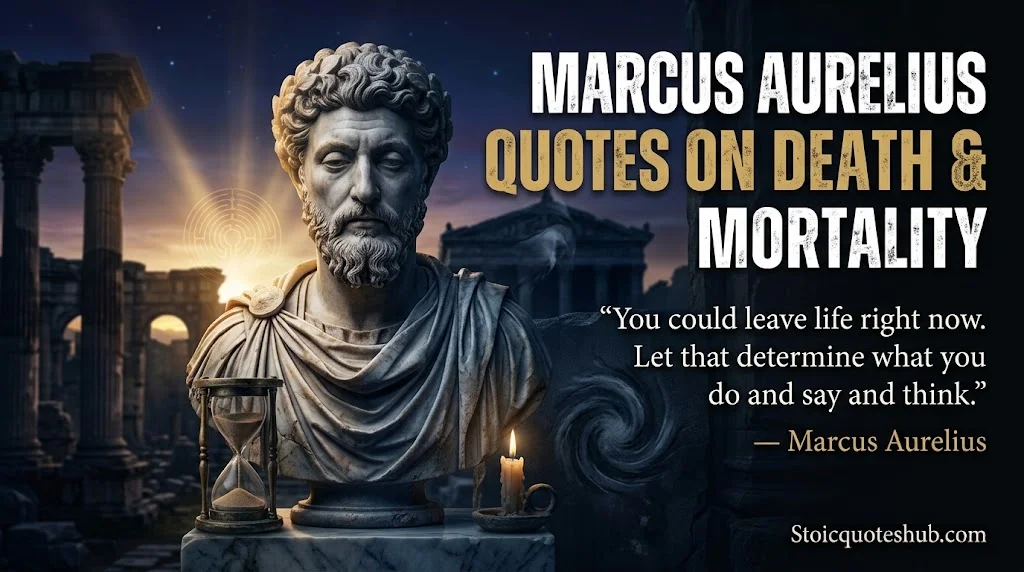
Stoics practiced a habit called memento mori — Latin for “remember you must die.” It sounds bleak, but Marcus used it as motivation, not despair.
“You could leave life right now. Let that determine what you do and say and think.” — Meditations 2.11
“Think of yourself as dead. You have lived your life. Now take what’s left and live it properly.” — Meditations 7.56
The goal wasn’t fear. It was urgency. If time is limited, wasted hours matter more, and petty arguments matter less.
“Do not act as if you were going to live ten thousand years. Death hangs over you. While you live, while it is in your power, be good.”
“Soon you will have forgotten all things: soon all things will have forgotten you.” — Meditations 7.21
“It is not death that a man should fear, but he should fear never beginning to live.”
One popular internet quote, “Death smiles at us all, but all a man can do is smile back,” gets attributed to Marcus constantly — including in movies. He never wrote it. It’s a well-known misattribution, and it’s worth knowing the difference between his actual words and the ones the internet added later.
“What we do now echoes in eternity.”
Marcus treated death as background noise, not a threat — a fact that made him bolder with the time he had, not more fearful of losing it.
Marcus Aurelius Quotes on Purpose, Forgiveness & Living Well

Marcus believed people are built to work together, not against each other, and that forgiveness comes easier once you understand why people act badly.
“To feel affection for people even when they make mistakes is uniquely human. You can do it too, if you simply recognize that they’re human too, that they act out of ignorance, against their will.” — Meditations 7.22
“When you wake up in the morning, tell yourself: the people I deal with today will be meddling, ungrateful, arrogant, dishonest, jealous, and surly. They are like this because they can’t tell good from evil.” — Meditations 2.1
This isn’t cynicism. It’s preparation. Marcus expected friction from people each morning so it wouldn’t catch him off guard — a practical trick for managing frustration and anger before it starts.
“The best revenge is not to be like your enemy.” — Meditations 6.6
“Waste no more time arguing about what a good man should be. Be one.” — Meditations 10.16
“No random actions, none not based on underlying principles.” — Meditations 4.2
“Very little is needed to make a happy life; it is all within yourself, in your way of thinking.” — Meditations 7.67
A few widely shared lines are often credited to Marcus but can’t be confirmed in Meditations itself — including “The universe is change; our life is what our thoughts make it” and “Be tolerant with others and strict with yourself.” They circulate everywhere online, but they’re best treated as popular attributions, not verified quotes, which is a distinction most quote lists skip entirely.
FAQs
Who was Marcus Aurelius and why are his Stoic quotes famous?
Marcus Aurelius was a Roman emperor who ruled from 161 to 180 CE. He’s famous for Meditations, a private journal of Stoic reflections he never intended to publish. His quotes are widely shared because they offer practical, calm advice on handling stress, anger, and mortality — written by someone who tested the ideas while running an empire.
What are the most powerful Marcus Aurelius Stoic quotes?
Some of the most quoted lines include “You have power over your mind — not outside events,” “The impediment to action advances action. What stands in the way becomes the way,” and “Waste no more time arguing about what a good man should be. Be one.”
What can Marcus Aurelius quotes teach us about life?
His quotes teach that you can’t control outside events, only your own judgment and response. He also emphasized doing less but doing it well, treating obstacles as opportunities, and living with urgency because time is limited.
What are the best Marcus Aurelius quotes about strength?
Key strength quotes include “The impediment to action advances action. What stands in the way becomes the way,” “If you seek tranquility, do less,” and his list of virtues anyone can practice: integrity, dignity, hard work, and self-denial.
What are the best Marcus Aurelius quotes about death?
His strongest death-related quotes include “You could leave life right now. Let that determine what you do and say and think” and “Think of yourself as dead. You have lived your life. Now take what’s left and live it properly.” Both use mortality as motivation, not fear.
Conclusion
Marcus Aurelius never wrote for an audience, which is exactly why his words still land. Each Marcus Aurelius quote here comes from a man testing Stoic philosophy against real pressure war, grief, and the daily weight of ruling an empire. Read a few lines when your own day feels heavy. Sometimes 1,900-year-old advice is still the clearest.

Danish Abroy is a writer and contributor at Stoic Quotes Hub, where he explores timeless ideas from Stoic philosophy and their relevance to modern life. His work focuses on meaningful quotes, practical wisdom, resilience, self-discipline, and developing a calmer perspective in everyday situations.