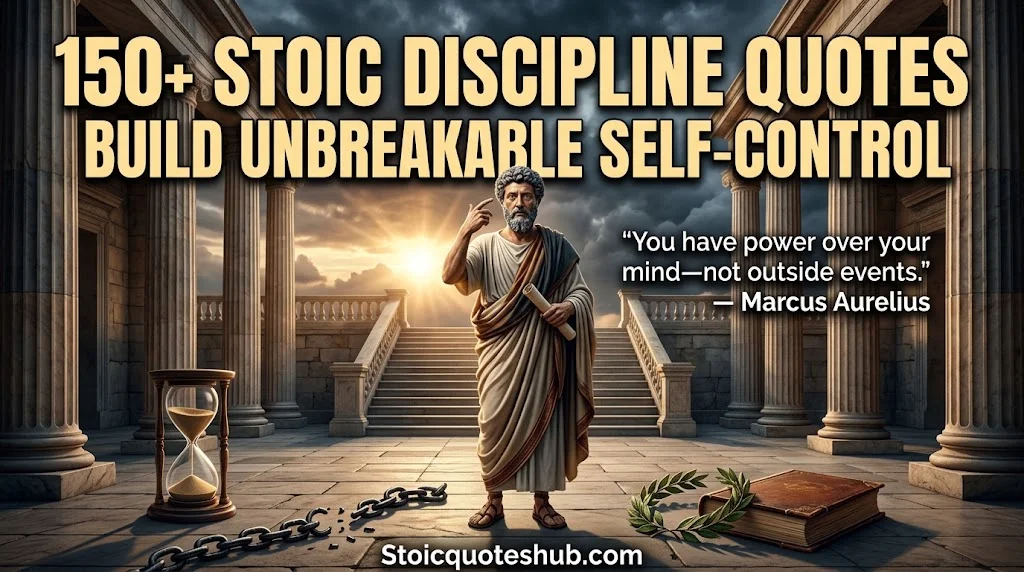
Stoic discipline quotes are over 1,800 years old, yet they fit today’s world of phones, snacks and stress. Each line trains one skill: choosing reason over impulse.
What is Stoic discipline? It is the daily habit of acting on reason instead of impulse. You control your thoughts, choices and actions. You let go of what you can’t control. Below are 151 Stoic quotes on discipline, plus simple ways to use them today.
Table of Contents
Best Stoic Discipline Quotes from Marcus Aurelius, Epictetus and Seneca

These three thinkers wrote the most about self-discipline. Their words in the Meditations, the Discourses, the Enchiridion and the Letters from a Stoic still shape how people think about self-mastery.
Marcus Aurelius (Meditations)
- “Waste no more time arguing what a good man should be. Be one.” — Meditations 10.16
- “The soul becomes dyed with the color of its thoughts.” — Meditations 5.16
- “If it is not right, do not do it. If it is not true, do not say it.” — Meditations 12.17
- “You can choose to have no opinion about a thing, and stay undisturbed.” — Meditations 6.52
- “What stands in the way becomes the way.” — Meditations 5.20
- “Do every act of your life as if it were your last.” — Meditations 2.5
- “Look within. Within is the fountain of good, and it will ever bubble up, if you will ever dig.” — Meditations 7.59
- “The best revenge is to be unlike the one who wronged you.” — Meditations 6.6
- “Confine yourself to the present.” — Meditations 8.36
- “Do not act as if you will live ten thousand years. While you live, while it is in your power, be good.” — Meditations 4.17
- “Loss is nothing but change, and change is Nature’s delight.” — Meditations 9.35
- “The universe is change; life is opinion.” — Meditations 4.3
- “How much more grievous are the consequences of anger than the causes of it.” — Meditations 11.18
- “Be like the headland against which the waves break. It stands, and the water around it falls still.” — Meditations 4.49
- “Very little is needed to make a happy life.” — Meditations 7.67
- “Never value as useful anything that forces you to break your word or lose your self-respect.” — Meditations 3.7
- “Receive without pride. Let go without a fight.” — Meditations 8.33
- “It is not death a man should fear, but never beginning to live.” — Meditations 12.1
- “A man’s worth is measured by the worth of what he cares about.” — Meditations 7.3
- “Choose not to feel harmed, and you are not harmed.” — Meditations 4.7
- “Think of yourself as dead. Take what is left and live it well.” — Meditations 7.56
- “When you wake, tell yourself: I rise to do a human being’s work.” — Meditations 5.1
- “Never let the future disturb you. You will meet it with the same weapons of reason that arm you against the present.” — Meditations 7.8
- “Each of us lives only in this present moment.” — Meditations 3.10
- “To change your mind and follow someone who corrects your error is as free as clinging to the error.” — Meditations 8.16
Epictetus (Discourses and Enchiridion)
- “No man is free who is not master of himself.” — Fragments
- “Men are disturbed not by things, but by the views they take of them.” — Enchiridion 5
- “Some things are up to us, and some are not.” — Enchiridion 1
- “First say to yourself what you would be. Then do what you have to do.” — Discourses 3.23
- “No great thing is created suddenly.” — Discourses 1.15
- “If you want to improve, be content to be thought foolish.” — Enchiridion 13
- “Wealth consists not in great possessions, but in few wants.” — Fragments
- “Make the best use of what is in your power, and take the rest as it happens.” — Discourses 1.1
- “Know first who you are. Then adorn yourself accordingly.” — Discourses 3.1
- “Only the educated are free.” — Discourses 2.1
- “Do not seek for events to happen as you wish. Wish for them to happen as they do, and you will be happy.” — Enchiridion 8
- “Sickness is an impediment to the body, but not to the will.” — Enchiridion 9
- “Remember you are an actor in a play, and the playwright chooses the role.” — Enchiridion 17
- “When you receive a pleasant impression, take care it does not carry you away.” — Enchiridion 34
- “Every event has two handles, one by which it can be carried and one by which it cannot.” — Enchiridion 43
- “It is not he who insults you, but your opinion of the insult, that harms you.” — Enchiridion 20
- “Practice in small things, and proceed to greater.” — Discourses
- “Difficulties show a person what they are.” — Discourses 1.24
- “If you wish to be a writer, write.” — Discourses 2.18
- “How long will you wait before you demand the best of yourself?” — Enchiridion 51
- “Whoever wishes to be free must not want what lies in another’s power.” — Enchiridion 14
- “You may fetter my leg, but not even Zeus can overcome my will.” — Discourses 1.1
- “Be silent for the most part, or speak only what is needed, and briefly.” — Enchiridion 33
- “Sheep do not show the shepherd how much they ate. They digest it and give wool and milk.” — Enchiridion 46
- “Wait for me a little, impression. Let me see what you are and what you stand for.” — Discourses 2.18
Seneca (Letters from a Stoic)
- “It is not that we have a short time to live, but that we waste much of it.” — On the Shortness of Life 1
- “We suffer more often in imagination than in reality.” — Letters 13
- “He suffers more than necessary who suffers before it is necessary.” — Letters 98
- “While we are postponing, life speeds by.” — Letters 1
- “Begin at once to live, and count each day as a separate life.” — Letters 101
- “Hold every hour in your grasp.” — Letters 1
- “It is not the man who has too little, but the man who craves more, that is poor.” — Letters 2
- “Most powerful is he who has himself in his own power.” — Letters 90
- “It is easier to keep our passions out than to rule them once they are in.” — Letters 116
- “The greatest remedy for anger is delay.” — On Anger 2.29
- “Anger is a brief madness.” — On Anger 1.1
- “No one is more unhappy than the man who never faces adversity.” — On Providence 3
- “Fire tests gold. Misfortune tests brave men.” — On Providence 5
- “Difficulties strengthen the mind, as labor does the body.” — On Providence 4
- “Fate leads the willing and drags the unwilling.” — Letters 107
- “It is not what you bear, but how you bear it.” — Letters 107
- “If a man does not know which port he sails to, no wind is favorable.” — Letters 71
- “It is not how long, but how well, you have lived that matters.” — Letters 77
- “Sometimes even to live is an act of courage.” — Letters 78
- “Withdraw into yourself, as far as you can.” — Letters 7
- “Whatever can happen at any time can happen today.” — Letters 91
- “Life is warfare.” — Letters 96
- “Choose someone whose way of life you admire, and keep them before you.” — Letters 11
- “What bad habit did you cure today? What fault did you resist?” — On Anger 3.36
- “Let us prepare our minds as if we had come to the very end of life. Let us postpone nothing.” — Letters 101
Stoic Quotes on Self-Control and Willpower

Discipline gets tested in small moments, like a craving, an insult or a delay. These Stoic self-control quotes are grouped by the moment you may face.
Impulse and temptation
- “If you do something good with hard work, the labor passes quickly but the good remains. If you do something shameful for pleasure, the pleasure passes quickly but the shame remains.” — Musonius Rufus
- “No one can be self-controlled who has not first trained against pleasure.” — Musonius Rufus
- “Behave in life as at a banquet. Take a modest share when the dish reaches you, and do not grab for what has not yet come.” — Epictetus, Enchiridion 15
- “On every occasion, ask what power you have to meet it: self-control against desire, endurance against pain, patience against abuse.” — Epictetus, Enchiridion 10
- “It is a sign of a dull mind to spend too much time on the body.” — Epictetus, Enchiridion 41
- “It is better to die of hunger, free from grief and fear, than to live in plenty and be troubled.” — Epictetus, Enchiridion 12
- “Do not be proud of an excellence that is not your own.” — Epictetus, Enchiridion 6
- “Nothing harms good character like idling at amusements. Vice slips in easily through pleasure.” — Seneca, Letters 7
- “A great fortune is a great slavery.” — Seneca, To Polybius 6
- “He is great who uses earthenware as if it were silver, and he who uses silver as if it were earthenware.” — Seneca, Letters 5
- “Cease to hope, and you will cease to fear.” — Seneca, Letters 5
- “If you shape your life by nature, you will never be poor. If you shape it by opinion, you will never be rich.” — Seneca, Letters 16
- “Take care that you are not made into a Caesar. Stay simple, good and pure.” — Marcus Aurelius, Meditations 6.30
Anger and emotional control
- “Begin each morning by telling yourself: today I will meet the meddler, the ungrateful and the arrogant.” — Marcus Aurelius, Meditations 2.1
- “When you are outraged at another person’s fault, turn to your own faults.” — Marcus Aurelius, Meditations 10.30
- “If an outside thing pains you, it is not the thing but your judgment of it that disturbs you. You can erase that judgment now.” — Marcus Aurelius, Meditations 8.47
- “Pain is neither unbearable nor unending, if you remember its limits.” — Marcus Aurelius, Meditations 7.64
- “The mind free from passions is a fortress.” — Marcus Aurelius, Meditations 8.48
- “How ridiculous is the man who is surprised by anything that happens in life.” — Marcus Aurelius, Meditations 12.13
- “If someone handed your body to a stranger, you would be furious. Why are you not ashamed to hand your mind to whoever insults you?” — Epictetus, Enchiridion 28
- “Never say ‘I have lost it.’ Say ‘I have given it back.’” — Epictetus, Enchiridion 11
- “Who is invincible? The one who cannot be shaken by anything outside his will.” — Epictetus, Discourses 1.18
- “You can be invincible if you enter no contest where victory is not up to you.” — Epictetus, Enchiridion 19
- “There are more things likely to frighten us than to crush us.” — Seneca, Letters 13
- “No tree becomes rooted and sturdy unless many winds assail it.” — Seneca, Letters 13
- “Disaster is virtue’s opportunity.” — Seneca, On Providence 4
Procrastination and time
- “You act like mortals in all that you fear, and like immortals in all that you desire.” — Seneca, On the Shortness of Life 3
- “Life is long, if you know how to use it.” — Seneca, On the Shortness of Life 2
- “Nothing is ours except time.” — Seneca, Letters 1
- “Remember how long you have been putting this off, and how often you were given chances you did not use.” — Marcus Aurelius, Meditations 2.4
- “Do not waste what is left of your life guessing about your neighbors.” — Marcus Aurelius, Meditations 3.4
- “Do what is in your hands at every moment with steady dignity, warmth, freedom and justice.” — Marcus Aurelius, Meditations 2.5
- “Perfection of character is to live each day as if it were your last, without frenzy, without apathy, without pretense.” — Marcus Aurelius, Meditations 7.69
- “If you seek tranquility, do less. Do only what is essential.” — Marcus Aurelius, Meditations 4.24
- “If a thing is humanly possible, believe it is within your reach.” — Marcus Aurelius, Meditations 6.19
- “Do not dwell on what you lack. Think of what you already have.” — Marcus Aurelius, Meditations 7.27
- “It is impossible to learn what you think you already know.” — Epictetus, Discourses 2.17
- “Well-being is attained little by little, and is yet no little thing.” — Zeno of Citium
Small daily habits and consistency
- “Every habit and ability is strengthened by its matching actions.” — Epictetus, Discourses 2.18
- “If you do not want to be hot-tempered, do not feed the habit. Give it nothing that helps it grow.” — Epictetus, Discourses 2.18
- “Keep to your rules as if they were laws.” — Epictetus, Enchiridion 50
- “When you decide to do something, never avoid being seen doing it.” — Epictetus, Enchiridion 35
- “Build your life action by action, and be content if each one reaches its goal.” — Marcus Aurelius, Meditations 8.32
- “If you slip, do not be discouraged. Return to your principles.” — Marcus Aurelius, Meditations 5.9
- “The art of living is more like wrestling than dancing.” — Marcus Aurelius, Meditations 7.61
- “No man was ever wise by chance.” — Seneca, Letters 76
- “Men learn while they teach.” — Seneca, Letters 7
- “Philosophy teaches us to act, not to talk.” — Seneca, Letters 20
- “Learning virtue without practicing it is of little use.” — Musonius Rufus
- “The goal is to live in agreement with nature.” — Zeno of Citium
Willpower and mental toughness
- “Within our power are opinion, impulse, desire and aversion.” — Epictetus, Enchiridion 1
- “As you guard against a nail underfoot, guard your ruling mind from harm.” — Epictetus, Enchiridion 38
- “Nothing happens to anyone that they are not fitted by nature to bear.” — Marcus Aurelius, Meditations 5.18
- “Let it make no difference whether you are cold or warm, if you are doing your duty.” — Marcus Aurelius, Meditations 6.2
- “Do not be ashamed to be helped. Your task is to do your duty like a soldier.” — Marcus Aurelius, Meditations 7.7
- “Nothing builds greatness of mind like examining each thing on your path with method and truth.” — Marcus Aurelius, Meditations 3.11
- “Is the cucumber bitter? Throw it away. Are there briars in the path? Turn aside.” — Marcus Aurelius, Meditations 8.50
- “People exist for one another. Teach them or put up with them.” — Marcus Aurelius, Meditations 8.59
- “Better to trip with the feet than with the tongue.” — Zeno of Citium
- “We have two ears and one mouth so we may listen twice as much as we speak.” — Zeno of Citium
- “A dog tied to a cart may trot along willingly or be dragged. Either way, it goes.” — image attributed to Zeno and Chrysippus
- “Lead me, Zeus, wherever you have posted me. I will follow without hesitation.” — Cleanthes, quoted in Epictetus, Enchiridion 53
- “You must change your soul, not your sky.” — Seneca, Letters 28
- “Real joy is a serious matter.” — Seneca, Letters 23
Voluntary discomfort, simple living and self-respect
- “Set aside days to live on the scantiest fare and roughest clothes. Then ask: is this what I feared?” — Seneca, Letters 18
- “Train the soul and body to bear cold, heat, thirst, hunger and scanty food.” — Musonius Rufus
- “Whatever anyone does or says, my task is to be good.” — Marcus Aurelius, Meditations 7.15
- “Dwell on the beauty of life. Watch the stars, and see yourself running with them.” — Marcus Aurelius, Meditations 7.47
- “I wonder how each man loves himself more than others, yet values his own opinion of himself less than theirs.” — Marcus Aurelius, Meditations 12.4
- “He is wise who does not grieve for what he lacks, but rejoices in what he has.” — Epictetus, Fragments
- “Keep company with those who bring out the best in you.” — Epictetus, Enchiridion 33
- “When you close the door and make darkness within, never say you are alone.” — Epictetus, Discourses 1.14
- “Give the mind rest. It rises sharper after it.” — Seneca, On Tranquility 17
- “Virtue is nothing other than right reason.” — Seneca, Letters 66
- “Live among people as if God were watching you.” — Seneca, Letters 10
- “If you wish to subject all things to yourself, subject yourself to reason.” — Seneca, Letters 37
Building unbreakable self-control through Stoic discipline is a daily practice, and powerful Stoic quotes of the day can provide fresh wisdom and motivation to stay focused on your path.
How to Use Stoic Discipline Quotes Daily
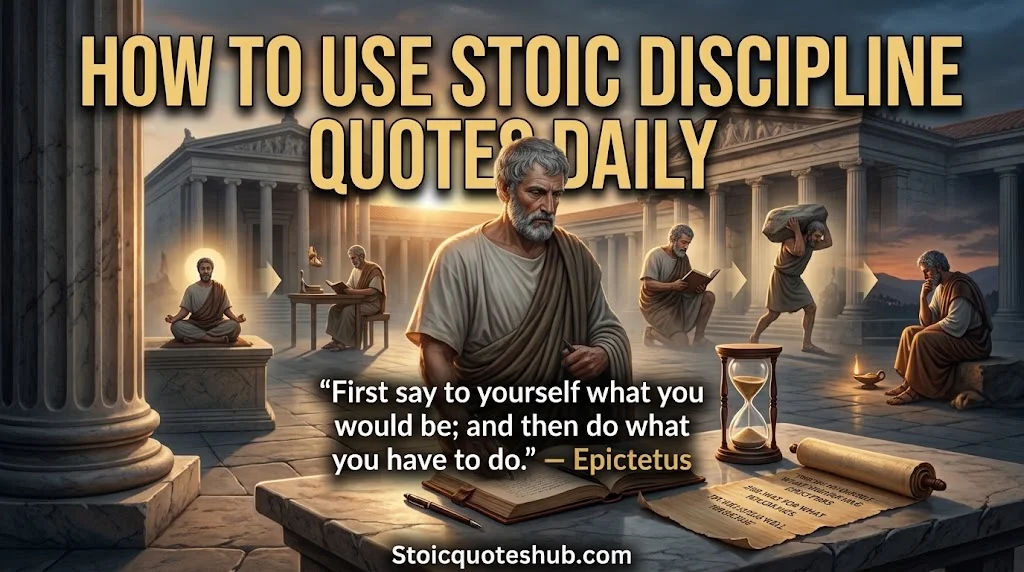
Reading quotes is the easy part. These short steps turn them into real self-control.
Why it works. Science backs the idea. Researchers followed about 1,000 children in Dunedin, New Zealand, from birth to age 32. Kids with stronger self-control grew into adults with better health, higher incomes and fewer criminal convictions. The Stoics trained this skill on purpose. Zeno of Citium founded Stoicism in Athens around 300 BC. Later, psychologist Albert Ellis drew on Epictetus when he built rational emotive behavior therapy, an early form of CBT.
Start with a morning reflection. Marcus Aurelius wrote the Meditations as private notes to himself. Do the same. Pick one quote and one virtue for the day. Write one sentence. That is enough.
End with an evening review. Seneca asked himself the same questions every night:
- What did I do well today?
- What did I do poorly?
- What will I do differently tomorrow?
Train three areas. Epictetus taught training in desire, action and judgment. In plain terms, that means discipline of perception, discipline of action and discipline of will.
- Perception: Describe a trigger in one neutral sentence. Facts only.
- Action: Before a choice, ask: “What would a person of character do?”
- Will: Split a problem into “I can change” and “I can’t.” Spend zero energy on the second list.
Practice voluntary discomfort. The Stoics called it askesis. Skip a snack. Take a cold shower. Sit with boredom instead of grabbing your phone. Small hardships build mental toughness.
Try this 7-day Stoic discipline plan.
- Day 1: Pick one quote. Write one personal rule for the day.
- Day 2: Pause for 10 seconds before reacting to anything.
- Day 3: Wait one hour before replying to a heated message.
- Day 4: Do your hardest task first, for 25 minutes.
- Day 5: Choose one small discomfort, such as a cold shower or no snacks.
- Day 6: Stay phone-free for one hour.
- Day 7: Do the evening review for the whole week.
Avoid common mistakes.
- Stoicism is not about hiding feelings. It is about not being ruled by them.
- Don’t go all-or-nothing. Marcus kept writing reminders because he often fell short. Discipline means returning, again and again.
- Don’t use Stoicism only as a productivity hack. The goal is virtue, not just output.
FAQs
What are the best Stoic discipline quotes?
Three stand out. Seneca: “Most powerful is he who has himself in his own power.” Epictetus: “No man is free who is not master of himself.” Marcus Aurelius: “Waste no more time arguing what a good man should be. Be one.” Each puts self-mastery into one line.
What is a famous Stoic quote about discipline?
A famous one is Epictetus’s “No man is free who is not master of himself.” It links discipline to freedom. You are only free when your impulses don’t run your choices. Many readers also cite Seneca’s “Most powerful is he who has himself in his own power.”
What do Stoics say about self-discipline?
The Stoics saw self-discipline as freedom, not punishment. They said to train your desires, actions and judgments with reason. Focus only on what you control: your thoughts and choices. Practice daily with reflection, small hardships and a nightly review.
How can Stoic discipline quotes improve your mindset?
They give your mind a short, repeatable rule at key moments. A line like “What stands in the way becomes the way” reframes an obstacle in seconds. Used daily, quotes build the habit of pausing, judging clearly and acting on reason. That steadies your mindset under stress.
What are the best Stoic quotes for self-control?
For self-control, try Epictetus: “On every occasion, ask what power you have to meet it.” Try Seneca: “The greatest remedy for anger is delay.” And try Seneca again: “It is easier to keep our passions out than to rule them once they are in.”
Conclusion
Stoic discipline is a practice, not a personality trait. Quotes help, but only when you act on them.
Pick one quote from this list today. Write it down. Use it at the next moment of temptation or anger. Repeat tomorrow.

Danish Abroy is a writer and contributor at Stoic Quotes Hub, where he explores timeless ideas from Stoic philosophy and their relevance to modern life. His work focuses on meaningful quotes, practical wisdom, resilience, self-discipline, and developing a calmer perspective in everyday situations.