Born into slavery, Epictetus became one of the most influential Stoic philosophers in history. His ideas shaped Roman emperors, and Stoic quotes from his teaching still fit modern life, from traffic jams to tough bosses.
This guide gives you 110+ Epictetus quotes with their sources, a short meaning for each and a few daily practices. The quotes come from the Enchiridion, the Discourses and the Fragments. They are lightly modernized from public-domain translations.
Table of Contents
Best Epictetus Quotes on Control and Mindset
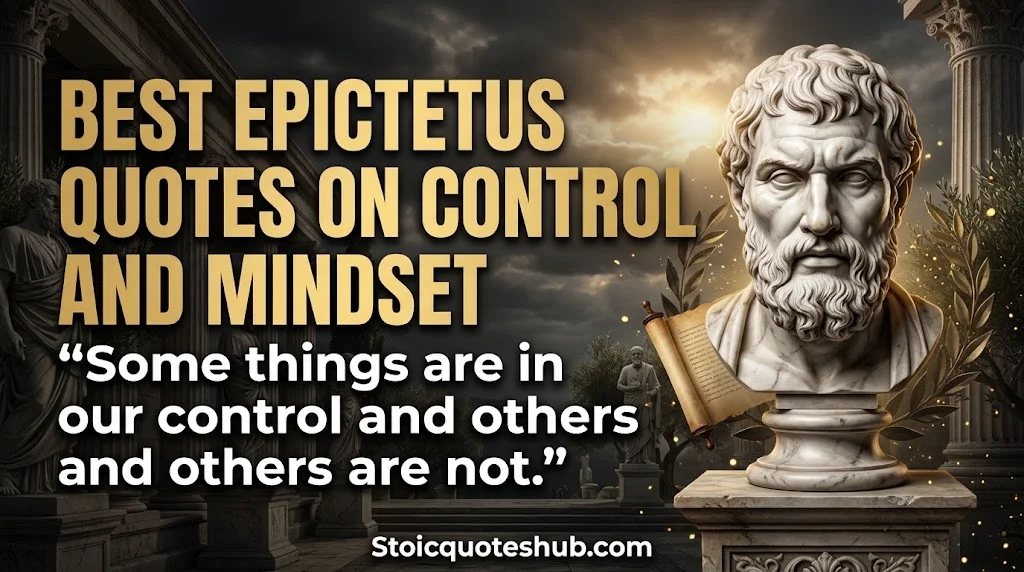
Epictetus built his teaching on the dichotomy of control: some things are up to you, and most are not. Start here, because every other quote builds on it.
- “Some things are up to us and some are not.” (Enchiridion 1) The base of Stoicism. Sort every problem into one pile or the other.
- “If you suppose that only to be your own which is your own, no one will ever compel you.” (Enchiridion 1) Own your choices, and no one can force them.
- “If you think what belongs to others is yours, you will be hindered and you will grieve.” (Enchiridion 1) Chasing what you can’t control is a fast road to stress.
- “Men are disturbed not by things, but by the views they take of them.” (Enchiridion 5) The most famous of all Epictetus quotes. Events are neutral. Judgments sting.
- “Don’t demand that things happen as you wish. Wish that they happen as they do, and you will go on well.” (Enchiridion 8) This is acceptance, not defeat.
- “Make the best use of what is in your power, and take the rest as it happens.” (Discourses 1.1) A plain rule for any bad day.
- “When you concern yourself with what is not your own, you lose what is your own.” (Discourses 1.25) Worry about other people’s opinions drains your own focus.
- “With every accident, ask yourself what abilities you have for making a proper use of it.” (Enchiridion 10) Every setback is a test of a skill you already hold.
Try this: Each morning, write one thing you control and one you don’t. Act on the first. Release the second.
- “Everything has two handles, one by which it can be carried and one by which it cannot.” (Enchiridion 43) Pick the handle that lets you move forward.
- “When you are about to begin any action, remind yourself what kind of action it is.” (Enchiridion 4) A form of negative visualization. Expect the mess in advance.
- “In every affair, consider what comes before and after, and then undertake it.” (Enchiridion 29) Look at the full cost before you commit.
- “First say to yourself what you would be; then do what you have to do.” (Discourses 3.23) Identity first, action second.
- “Know first who you are, and then adorn yourself accordingly.” (Discourses 3.1) Choose your values before you choose your image.
- “It is impossible for a man to learn what he thinks he already knows.” (Discourses 2.17) Certainty blocks growth. Stay curious.
- “If you want to improve, be content to be thought foolish and stupid about externals.” (Enchiridion 13) Growth means looking clumsy in public for a while.
- “Whatever rules you have laid down, abide by them as laws.” (Enchiridion 50) Self-discipline is keeping your own promises.
Try this: Pick one rule for this week, such as “no phone before 8 a.m.” Treat it as law.
- “How long will you wait before you demand the best of yourself?” (Enchiridion 51) Today is the answer.
- “When you do something because you judge it right, never shrink from being seen doing it.” (Enchiridion 35) Do right openly, even if people misread you.
- “Take care not to hurt the ruling faculty of your mind, as you take care not to step on a nail.” (Enchiridion 38) Guard your mind the way you guard your feet.
- “Do not be proud of any excellence that is not your own.” (Enchiridion 6) Looks, family names and luck are not achievements.
- “An uninstructed person looks for benefit and harm from outside. A philosopher looks for both from himself.” (Enchiridion 48) Mature people stop blaming the weather.
- “A person making progress blames no one, praises no one, and complains of no one.” (Enchiridion 48) A clear sign of inner growth.
- “Every habit and faculty is strengthened by its matching actions.” (Discourses 2.18) You become what you repeat.
- “Practice yourself in little things, and then proceed to greater.” (Discourses) Small reps build large strength.
Try this: Choose one tiny habit today, like making your bed. Repeat it for seven days.
- “Remember that you are an actor in a play. The author chooses your part; play it well.” (Enchiridion 17) You can’t pick the role, only the performance.
- “If you turn to externals to please anyone, you have lost your purpose in life.” (Enchiridion 23) People-pleasing costs you your direction.
- “Prescribe some character and form of conduct for yourself, and keep it both alone and in company.” (Enchiridion 33) Be the same person in private and in public.
- “If you are fond of a ceramic cup, remember it is a ceramic cup. Then you won’t be disturbed if it breaks.” (Enchiridion 3) Enjoy things without clinging to them.
- “‘I am richer than you, so I am better’ does not follow. ‘I am richer, so my property is greater’ does.” (Enchiridion 44) Wealth describes what you own, not who you are.
- “Things are indifferent, but the use of them is not.” (Discourses 2.5) Money, fame and health are tools. How you use them is the test.
- “Things either are what they seem, or neither are nor seem, or are and don’t seem, or aren’t and yet seem.” (Discourses 1.27) A reminder to check your perception before you react.
- “The person who will be good must train three areas: desires, impulses to act, and assent.” (Discourses 3.2) A short map of the whole Stoic path.
Stoic Epictetus Quotes on Emotions and Inner Peace

For Epictetus, emotions follow judgments, not events. Change the judgment, and the feeling changes too. Modern therapy agrees. Aaron Beck wrote that the philosophical origins of cognitive therapy trace back to the Stoics, Epictetus among them. The REBT method also grew from his words.
- “It is not he who reviles or strikes you who insults you, but your opinion that these things are insulting.” (Enchiridion 20) A rude email only hurts if you agree it should.
- “When someone provokes you, it is your own opinion that provokes you.” (Enchiridion 20) You hold the switch.
- “Say to every harsh impression: ‘You are an impression, and not at all what you appear to be.'” (Enchiridion 1) A cognitive reappraisal tool, 2,000 years early.
- “Wait a little, impression. Let me see what you are, and let me test you.” (Discourses 2.18) Pause first. React second.
- “Death is nothing terrible. The terror lies in our judgment that it is terrible.” (Enchiridion 5) Fear lives in the opinion, not the event.
- “When we are hindered, disturbed or grieved, let us never blame others, but ourselves.” (Enchiridion 5) Look at your own thinking first.
- “Blaming others for your troubles shows a lack of education. Blaming yourself shows a start. Blaming neither shows it is complete.” (Enchiridion 5) Three steps of emotional maturity.
- “If someone gave your body to any passerby, you’d be angry. Why do you give your mind to anyone who insults you?” (Enchiridion 28) Don’t hand strangers the keys to your mood.
- “Whenever you are angry, know that you have not only a present evil but have also increased a habit.” (Discourses 2.18) Every outburst trains the next one.
Try this: When anger rises, breathe for ten seconds and name the judgment behind it.
- “When someone treats you badly, remember he does it because he thinks it is right.” (Enchiridion 42) Seeing his view takes the sting out.
- “Before you understand the circumstances, how do you know he has acted badly?” (Enchiridion 45) A cure for snap judgments and online pile-ons.
- “If your brother wrongs you, do not take it by the handle of his wrongdoing. Take it by the handle that he is your brother.” (Enchiridion 43) Hold onto the bond, not the hurt.
- “Why be angry with those who go wrong? They are mistaken about what is good and bad.” (Discourses 1.18) Pity works better than rage.
- “If you are told someone speaks ill of you, answer: ‘He did not know my other faults, or he would not have mentioned only these.'” (Enchiridion 33) A calm reply with a touch of humor.
- “Let your talk not be of gladiators, horse races or food, and above all not of people, blaming or comparing.” (Enchiridion 33) Skip the gossip. It leaves you lighter.
- “Be silent for the most part, or speak briefly, and only what is necessary.” (Enchiridion 33) Short words keep the peace.
Try this: In your next tense talk, wait two seconds before you answer.
- “Let death, exile and all things that seem terrible be daily before your eyes.” (Enchiridion 21) Facing fear early shrinks it.
- “It is not death or pain that is to be dreaded, but the fear of pain or death.” (Discourses) Fear of the thing outgrows the thing.
- “When you receive an impression of pleasure, let it wait. Compare the time you enjoy it with the time you regret it.” (Enchiridion 34) A fine rule for late-night scrolling and snacks.
- “Never say ‘I have lost it.’ Say ‘I have returned it.'” (Enchiridion 11) A gentler way to hold loss.
- “When a neighbor’s cup breaks, we say ‘such things happen.’ Feel the same when your own breaks.” (Enchiridion 26) Treat your bad luck like anyone else’s.
- “When you see someone weeping in grief, sympathize with him. Just do not let yourself groan inwardly.” (Enchiridion 16) Care for others without drowning with them.
- “To wish that your children, wife and friends live forever is silly, for you wish for what is not in your power.” (Enchiridion 14) Love fully, and know that nothing lasts.
- “Desire promises you will get what you want. Aversion promises you will escape what you dislike.” (Enchiridion 2) Fail at either, and you suffer. Aim your desires well.
- “Has someone been preferred before you? If it is good, be glad he has it. If it is bad, do not grieve you lack it.” (Enchiridion 25) A direct fix for envy and comparison.
- “Do not envy the person who bought the lettuce if you did not pay the price. You kept your coin.” (Enchiridion 25) Every prize has a cost. You chose not to pay it.
- “If shame is an evil, no one else can bring it upon you.” (Enchiridion 24) Your dignity can’t be taken.
- “Nothing is got for nothing. Calm has its price.” (Enchiridion 12) Inner peace takes daily effort.
Epictetus Quotes on Strength and Resilience
Epictetus treated hardship as training. US Navy pilot James Stockdale lived that idea. He was shot down over North Vietnam in September 1965 and spent eight years as a prisoner of war, four of them in solitary. He credited Epictetus for helping him endure. His essay Courage Under Fire tells the story.
- “Difficulties are things that show what men are.” (Discourses 1.24) Pressure reveals character. It doesn’t build it from nothing.
- “When trouble comes, remember that God, like a trainer of wrestlers, has matched you with a rough young man.” (Discourses 1.24) Epictetus meant divine reason. Read it as: this fight is making you stronger.
- “You will chain my leg, but not even Zeus can overcome my will.” (Discourses 1.1) The mind stays free when the body doesn’t.
- “You can be invincible if you enter no contest where victory is not up to you.” (Enchiridion 19) Pick fights you can win by your own effort.
- “Sickness is an impediment to the body, but not to the will. Lameness is an impediment to the leg, but not to the will.” (Enchiridion 9) Ancient sources say Epictetus was lame himself.
- “No great thing is created suddenly, any more than a bunch of grapes or a fig.” (Discourses 1.15) Patience is part of any big goal.
- “Do you want to win at the Olympic games? So do I. But first consider what comes before it and after it.” (Enchiridion 29) Know the training before you chase the medal.
- “If you ignore the cost, you will act like children who play wrestler, then gladiator, then trumpeter.” (Enchiridion 29) Quitting early is a habit. Commit to one path.
- “If you want to take up philosophy, prepare to be laughed at.” (Enchiridion 22) Change draws mockery. Keep going.
Try this: Name one hard task you’ve avoided. Do ten minutes of it today.
- “You are no longer a boy, but a grown man. What teacher are you still waiting for?” (Enchiridion 51) You already know enough to start.
- “Remember: the contest is now. In one day, one action, progress is lost or kept.” (Enchiridion 51) Each day counts.
- “If you take a role above your strength, you disgrace yourself in it and neglect one you could have filled.” (Enchiridion 37) Know your limits, and grow past them one step at a time.
- “What would have become of Hercules without the lion, the hydra, the stag and the boar?” (Discourses 1.6) Obstacles are what heroes are made from.
- “We should not moor a ship with one anchor, nor build a life on one hope.” (Fragments) Spread your hopes. One loss shouldn’t sink you.
- “If you wish to be a writer, write.” (Discourses) Doing beats planning.
- “Better to die of hunger free of grief and fear than live in plenty with anxiety.” (Enchiridion 12) Peace of mind outranks comfort.
- “On a voyage, don’t let shellfish and little roots distract you. When the captain calls, go aboard.” (Enchiridion 7) Small pleasures shouldn’t pull you off course.
- “For me every omen is favorable, whatever happens, for I can gain benefit from it.” (Enchiridion 18) Any event can become fuel.
Try this: After a setback, ask: “What can this teach me?” Write one line.
- “Bear and forbear.” (Epictetus, as reported by Aulus Gellius, Attic Nights 17.19) Two words that sum up Stoic discipline: endure pain, resist excess.
- “Show me someone who is sick yet happy, in danger yet happy, dying yet happy, in exile yet happy.” (Discourses 2.19) A challenge to prove your philosophy under strain.
- “Progress means turning away from externals and toward your own will, to train it.” (Discourses 1.4) Real growth happens inside.
- “When you go to bathe, say: ‘I will bathe and keep my will in harmony with nature.'” (Enchiridion 4) Prepare for small annoyances, like crowded gyms and rude drivers.
- “Who is invincible? The one whom nothing outside his will can disturb.” (Discourses) Resilience in one sentence.
- “The struggle is great and the task divine: freedom, calm and peace.” (Discourses 2.18) The prize is worth the work.
- “Crito, if it pleases the gods, so be it.” (Enchiridion 53, quoting Socrates) Face the end with steady acceptance.
- “Anytus and Meletus can kill me, but they cannot hurt me.” (Enchiridion 53, quoting Socrates) Only your own choices can truly harm you.
- “Lead me, Zeus and Destiny, wherever you have assigned me. I will follow without hesitation.” (Enchiridion 53, quoting Cleanthes) Willing acceptance of fate is a strength.
Epictetus emphasized mastering your thoughts, reactions, and choices as the foundation of a stronger life. Put these timeless principles into practice with these powerful Stoic quotes on self-control to strengthen discipline and build a more resilient mind.
Powerful Epictetus Quotes on Life, Freedom and Self-Mastery
Epictetus said true freedom starts inside. These quotes cover how to live well, choose your character and own your actions.
- “Whoever wishes to be free should neither wish for nor avoid anything that depends on others.” (Enchiridion 14) Freedom starts when you stop needing others to cooperate.
- “He is free who lives as he wishes to live.” (Discourses 4.1) Wishing wisely is the trick.
- “Freedom is not won by satisfying desire, but by removing it.” (Discourses 4.1) Fewer demands, more liberty.
- “No man is free who is not master of himself.” (Fragments) Self-mastery comes before every other freedom.
- “Only the educated are free.” (Discourses 2.1) He meant learning how to think and choose.
- “Sheep do not show the shepherd how much they have eaten. They digest it and give wool and milk.” (Enchiridion 46) Show results, not talk.
- “Don’t explain your philosophy. Embody it.” (Common paraphrase of Enchiridion 46) Not a literal line, but it matches his message.
- “If you admire the explanation but don’t act on it, you have become a grammarian instead of a philosopher.” (Enchiridion 49) Reading isn’t practice.
Try this: Pick one quote from this page and live it for one full day.
- “Behave in life as at a banquet. Take a moderate share of what passes, and don’t reach for what has gone.” (Enchiridion 15) A guide to moderation.
- “When you have become used to living simply, do not be proud of it.” (Enchiridion 47) Do the work without bragging.
- “The body is the measure of what you need, as the foot is the measure of the shoe.” (Enchiridion 39) Buy what fits. Skip the rest.
- “It is a mark of a dull mind to spend too much time on the body.” (Enchiridion 41) Care for your health, but feed your mind too.
- “Duties are measured by relationships. A father may be hard, but he is still your father.” (Enchiridion 30) Do your part, whatever others do.
- “In prosperity it is easy to find a friend. In adversity it is the hardest thing of all.” (Fragments) Real friends show up when it’s hard.
- “First learn the meaning of what you say, and then speak.” (Discourses) Think, then talk.
- “Leave your sons well instructed rather than rich.” (Fragments) Education outlasts money.
- “You are a little soul carrying around a corpse.” (Quoted by Marcus Aurelius, Meditations 4.41) A blunt nudge to value character over looks.
- “God has entrusted me with myself.” (Discourses 4) Your life is your duty to manage well.
- “If I were a nightingale, I would sing as a nightingale. I am a rational being, so I must praise God.” (Discourses 1.16) Do the task your nature gives you.
- “As a target is not set up to be missed, so nothing evil exists in the world.” (Enchiridion 27) A view of the world as ordered, not hostile.
- “You are a distinct portion of the being of God, and carry a part of him within you.” (Discourses 2.8) Epictetus saw each person as worth respect.
- “Consider who you are. First a human being, then a citizen of the world, then a son and a brother.” (Discourses 2.10) Your roles bring duties.
- “The first and most necessary topic in philosophy is the use of principles, such as ‘we ought not to lie.'” (Enchiridion 52) Honesty comes first.
- “If evil is spoken of you and it is true, correct yourself. If it is a lie, laugh at it.” (Fragments) Learn from fair criticism. Let the rest go.
- “The material for the art of living is each person’s own life.” (Discourses 1.15) Your days are the clay.
FAQs
Who was Epictetus and why are his Stoic quotes so powerful?
Epictetus was born around 50 CE in Hierapolis, in present-day Turkey. He was enslaved in Rome, later freed, and taught philosophy until Emperor Domitian banished philosophers. He then founded a school in Nicopolis, Greece. His student Arrian recorded his talks. His words hit hard because he lived them. See Britannica and the Stanford Encyclopedia of Philosophy.
What are the best Stoic Epictetus quotes about life?
Top picks include “Some things are up to us and some are not,” “First say to yourself what you would be; then do what you have to do,” and “He is free who lives as he wishes to live.” All three teach one idea: choose your values, then act on them daily. Read the full texts in the Enchiridion and Discourses.
What are the most famous Epictetus quotes?
The best known is “Men are disturbed not by things, but by the views they take of them.” Next come “No man is free who is not master of himself” and “If you want to improve, be content to be thought foolish.” Some popular lines are not his. The “two ears, one mouth” saying is usually traced to Zeno, and “The world turns aside to let any man pass who knows where he is going” is usually credited to David Starr Jordan.
What did Epictetus say about controlling your emotions?
He taught that emotions come from judgments, not events. So pause, test the first impression, and ask, “Is this up to me?” He also warned that anger grows into a habit. This idea shaped modern CBT. Albert Ellis, the founder of REBT, argued, following Epictetus, that beliefs about events upset us, not the events themselves.
What are the best Epictetus quotes about strength and resilience?
Try “Difficulties are things that show what men are,” “You can be invincible if you enter no contest where victory is not up to you,” and “You will chain my leg, but not even Zeus can overcome my will.” Each treats hardship as training. Build strength through small daily practice, not one big leap.
Conclusion
Epictetus offers one lesson above all: focus only on what you control. Pick one quote from this list and practice it today. Small, steady choices are how you transform your mind and master your life.

Danish Abroy is a writer and contributor at Stoic Quotes Hub, where he explores timeless ideas from Stoic philosophy and their relevance to modern life. His work focuses on meaningful quotes, practical wisdom, resilience, self-discipline, and developing a calmer perspective in everyday situations.