
Most of us feel thankful only when life goes our way, and that makes our peace of mind fragile. These Stoic quotes on gratitude from Seneca, Epictetus, and Marcus Aurelius show you how to feel thankful in good times and hard times.
Table of Contents
Best Stoic Quotes on Gratitude From Seneca, Epictetus & Marcus Aurelius
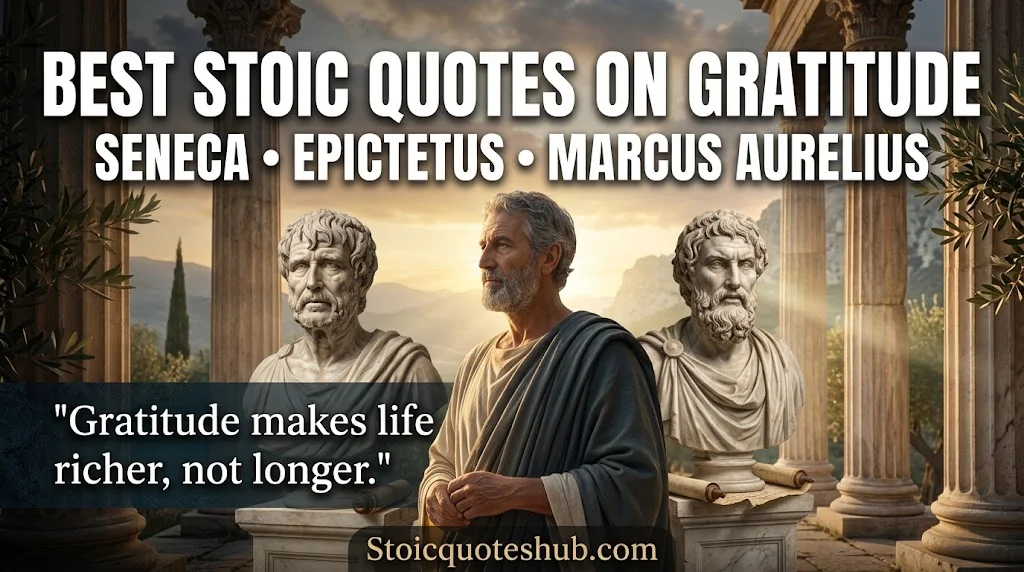
The three great Stoic voices each treat gratitude differently. Seneca saw thanks as a duty, Epictetus as a habit of wanting less, and Marcus Aurelius as a way of noticing what he already had.
Stoicism began in Athens around 300 BC, when Zeno of Citium taught under a painted porch called the Stoa. You can read the history of the school in the Stanford Encyclopedia of Philosophy. Wording below follows older English translations, so check the source before you cite a line.
Seneca quotes on gratitude
Seneca wrote On Benefits (De Beneficiis), a seven-book study of giving and receiving kindness. His Letters to Lucilius add more lines on thanks and time.
- “Nothing is more honorable than a grateful heart.” — Seneca
- “He who receives a benefit with gratitude repays the first installment on his debt.” — On Benefits 2.22
- “There is as much greatness of mind in acknowledging a good turn as in doing it.” — Seneca
- “Wherever there is a human being, there is an opportunity for a kindness.” — On the Happy Life
- “Let the man who would be grateful think of repaying a kindness, even while receiving it.” — Seneca
- “He who has done a kindness should be silent; he who has received one should speak of it.” — On Benefits 2.10
- “A gift consists not in what is done or given, but in the intention of the giver.” — On Benefits 1.6
- “Gratitude returns in large measure unto itself.” — Letter 81
- “The wages of a good deed is to have done it.” — Letter 81
- “I feel grateful, not because it profits me, but because it pleases me.” — Letter 81
- “It is not the man who has too little, but the man who craves more, that is poor.” — Letter 2
- “If you live according to nature, you will never be poor; if according to opinion, you will never be rich.” — Letter 16
- “If you admit to having derived great pleasures, your duty is not to complain about what has been taken away but to be thankful for what you have been given.” — Seneca
- “True happiness is to enjoy the present, without anxious dependence upon the future.” — On the Happy Life
- “A wise man is content with his lot, whatever it may be, without wishing for what he has not.” — On the Happy Life
- “The greatest blessings of mankind are within us and within our reach.” — On the Happy Life
- “Nothing, Lucilius, is ours, except time.” — Letter 1
- “While we are postponing, life speeds by.” — Letter 1
- “Life is long, if you know how to use it.” — On the Shortness of Life
- “Begin at once to live, and count each separate day as a separate life.” — Letter 101
- “Let us balance life’s books each day.” — Letter 101
- “He is most powerful who has power over himself.” — Letter 113
- “A cheerful poverty is an honorable thing.” — Letter 2 (Seneca citing Epicurus)
- “True joy is a serious thing.” — Letter 23
- “Is this the condition that I feared?” — Letter 18, asked after a few days of simple living
Seneca’s big idea is simple. Gratitude is not only polite. It rewards the person who feels it.
Epictetus quotes on gratitude
Epictetus was born enslaved and later taught in Rome. His student Arrian wrote down his Discourses and the short Enchiridion.
- “He is a wise man who does not grieve for the things which he has not, but rejoices for those which he has.” — Epictetus
- “Wealth consists not in having great possessions, but in having few wants.” — Epictetus (attributed)
- “Remember that you must behave in life as at a dinner party. Is anything brought around to you? Put out your hand and take your share with moderation.” — Enchiridion 15
- “What else can I, a lame old man, do but sing hymns to God?” — Discourses 1.16
- “Some things are up to us and some are not up to us.” — Enchiridion 1
- “Make the best use of what is in your power, and take the rest as it happens.” — Discourses 1.1
- “Don’t demand that things happen as you wish, but wish that they happen as they do happen, and you will go on well.” — Enchiridion 8
- “Men are disturbed not by things, but by the views which they take of them.” — Enchiridion 5
- “It is the action of an uninstructed person to blame others for his own bad condition.” — Enchiridion 5
- “First say to yourself what you would be; then do what you have to do.” — Discourses 3.23
- “No man is free who is not master of himself.” — Epictetus
- “Never say of anything, ‘I have lost it,’ but ‘I have returned it.'” — Enchiridion 11
- “It is difficulties that show what men are.” — Discourses 1.24
The banquet image is the heart of Epictetus. Take what is passed to you, enjoy it, and do not grab for what has not arrived.
Marcus Aurelius quotes on gratitude
Meditations was a private journal, not a book for readers. Book 1 reads like a thank-you list to the people who shaped him.
- “From my grandfather Verus I learned good morals and the government of my temper.” — Meditations 1.1
- “From my mother, piety and generosity, and abstinence not only from evil deeds but even from evil thoughts.” — Meditations 1.3
- “From Sextus, a benevolent disposition.” — Meditations 1.9
- “From my brother Severus, to love my kin, and to love truth, and to love justice.” — Meditations 1.14
- “To the gods I am indebted for having good grandfathers, good parents, a good sister, good teachers, good associates, good kinsmen and friends, nearly everything good.” — Meditations 1.17
- “In the morning, when you rise unwillingly, let this thought be present: I am rising to the work of a human being.” — Meditations 5.1
- “Do not indulge in dreams of having what you have not, but reckon up the chief of the blessings you do possess, and then thankfully remember how you would crave for them if they were not yours.” — Meditations 7.27
- “Pass through this brief patch of time in harmony with nature, and come to your final resting place gracefully, just as a ripened olive might drop, praising the earth that nourished it and grateful to the tree that gave it growth.” — Meditations 4.48
- “Everything is fruit to me which your seasons bring, O Nature.” — Meditations 4.23
- “Do not be ashamed to be helped.” — Meditations 7.7
- “Love the art, poor as it may be, which you have learned, and be content with it.” — Meditations 4.31
- “Think of yourself as dead. You have lived your life. Now take what’s left and live it properly.” — Meditations 7.56
- “You could leave life right now. Let that determine what you do and say and think.” — Meditations 2.11
- “Remember how long you’ve been putting this off, and how many extensions the gods gave you.” — Meditations 2.4
- “Do not act as if you were going to live ten thousand years. Death hangs over you. While you live, while it is in your power, be good.” — Meditations 4.17
- “The perfection of moral character is to spend each day as if it were your last.” — Meditations 7.69
- “Everything is only for a day, both that which remembers and that which is remembered.” — Meditations 4.35
- “Begin the morning by saying to yourself: I shall meet the busybody, the ungrateful, the arrogant.” — Meditations 2.1
- “Waste no more time arguing about what a good man should be. Be one.” — Meditations 10.16
- “Receive without conceit, release without struggle.” — Meditations 8.33
- “All those things at which you hope to arrive by a roundabout road, you can have now, if you do not refuse them to yourself.” — Meditations 12.1
Marcus links thanks to death. When you remember life is short, small things look bigger.
Quote check: Online lists often credit “Who is rich? He who is content” to Epictetus. It comes from the Jewish text Pirkei Avot (4:1), where Ben Zoma says it. The line “A grateful mind is a great mind” is widely credited to Plato, but it is usually listed without a clear source. Every quote above is tied to a named work or an author.
Stoic Quotes on Gratitude for Hard Times, Loss & Inner Peace

Stoic gratitude is not only for good days. These Stoic quotes about being thankful help you stay calm through loss, setbacks, and the urge to want more.
Gratitude in adversity and amor fati
Amor fati means “love of fate.” Nietzsche coined the phrase, but the idea is Stoic: accept what happens and use it.
- “Fire tests gold, adversity tests brave men.” — Seneca, On Providence
- “Misfortune is virtue’s opportunity.” — Seneca, On Providence
- “No man is crushed by misfortune unless he has first been deceived by prosperity.” — Seneca, Letter 4
- “Difficulties strengthen the mind, as labor does the body.” — Seneca
- “Sometimes even to live is an act of courage.” — Seneca, Letter 78
- “It is not because things are difficult that we do not dare; it is because we do not dare that they are difficult.” — Seneca, Letter 104
- “Fate leads the willing and drags the unwilling.” — Cleanthes, as rendered by Seneca in Letter 107
- “Whatever happens at all happens as it should.” — Marcus Aurelius, Meditations 4.10
- “What stands in the way becomes the way.” — Marcus Aurelius, Meditations 5.20
- “Accept the things to which fate binds you, and love the people with whom fate brings you together, but do so with all your heart.” — Marcus Aurelius, Meditations 6.39
- “Loss is nothing but change.” — Marcus Aurelius, Meditations 9.35
- “My formula for greatness in a human being is amor fati: that one wants nothing to be different.” — Friedrich Nietzsche, Ecce Homo
Stoic quotes for inner peace and a calm mind
The Stoic word for calm is ataraxia. These lines show that inner peace starts with how you judge events, not with the events.
- “Very little is needed to make a happy life; it is all within yourself, in your way of thinking.” — Marcus Aurelius, Meditations 7.67
- “Look within. Within is the fountain of good.” — Marcus Aurelius, Meditations 7.59
- “The soul becomes dyed with the color of its thoughts.” — Marcus Aurelius, Meditations 5.16
- “If you are distressed by anything external, the pain is not due to the thing itself, but to your estimate of it.” — Marcus Aurelius, Meditations 8.47
- “Today I escaped from anxiety. Or no, I discarded it, because it was within me, in my own perceptions.” — Marcus Aurelius, Meditations 9.13
- “Be like the promontory against which the waves continually break.” — Marcus Aurelius, Meditations 4.49
- “Don’t let your imagination be crushed by life as a whole.” — Marcus Aurelius, Meditations 8.36
- “Nowhere does a man retire with more quiet or more freedom from trouble than into his own soul.” — Marcus Aurelius, Meditations 4.3
- “How easy it is to repel and wipe out every impression which is troublesome or unsuitable, and immediately to be in all tranquility.” — Marcus Aurelius, Meditations 5.2
- “We suffer more often in imagination than in reality.” — Seneca, Letter 13
- “There are more things likely to frighten us than to crush us.” — Seneca, Letter 13
- “Wretched is the mind anxious about the future.” — Seneca, Letter 98
- “Happiness is a good flow of life.” — Zeno of Citium
Stoic-minded thinkers on gratitude
These voices are not strict Stoics. Their lines echo the same ideas, so they sit well beside the ancients.
- “Nothing is enough for the man to whom enough is too little.” — Epicurus
- “Do not spoil what you have by desiring what you have not; remember that what you now have was once among the things you only hoped for.” — Epicurus
- “The wealth required by nature is limited and is easy to procure.” — Epicurus
- “The ungrateful greed of the soul makes the creature everlastingly desire varieties of dainties.” — Epicurus
- “He who forgets the good that he has had is today an old man.” — Epicurus
- “The desire for imaginary benefits often involves the loss of present blessings.” — Aesop
- “Gratitude is the sign of noble souls.” — Aesop (attributed)
- “Gratitude is not only the greatest of virtues, but the parent of all the others.” — Cicero, Pro Plancio
- “He who knows he has enough is rich.” — Lao Tzu, Tao Te Ching
- “When you realize there is nothing lacking, the whole world belongs to you.” — Lao Tzu, Tao Te Ching
- “Love your life, poor as it is.” — Henry David Thoreau, Walden
- “I am grateful for what I am and have. My thanksgiving is perpetual.” — Henry David Thoreau
- “For everything you have missed, you have gained something else.” — Ralph Waldo Emerson
- “Reflect upon your present blessings, of which every man has many, not on your past misfortunes, of which all men have some.” — Charles Dickens
- “Acknowledging the good that you already have in your life is the foundation for all abundance.” — Eckhart Tolle
- “Let us be grateful to people who make us happy; they are the charming gardeners who make our souls blossom.” — Marcel Proust
- “We can only be said to be alive in those moments when our hearts are conscious of our treasures.” — Thornton Wilder
- “Many times a day I realize how much my own outer and inner life is built upon the labors of my fellow men, both living and dead.” — Albert Einstein
- “Everything can be taken from a man but one thing: the last of the human freedoms, to choose one’s attitude in any given set of circumstances.” — Viktor Frankl
- “The highest appreciation is not to utter words, but to live by them.” — John F. Kennedy
- “The deepest principle in human nature is the craving to be appreciated.” — William James
- “It is not happiness that makes us grateful. It is gratefulness that makes us happy.” — Brother David Steindl-Rast
- “O Lord that lends me life, lend me a heart replete with thankfulness!” — William Shakespeare
- “He gives twice who gives quickly.” — Publilius Syrus
- “Gratitude is the memory of the heart.” — Jean-Baptiste Massieu (attributed)
- “At times our own light goes out and is rekindled by a spark from another person.” — Albert Schweitzer
- “Gratitude unlocks the fullness of life. It turns what we have into enough, and more.” — Melody Beattie
- “Wear gratitude like a cloak and it will feed every corner of your life.” — Rumi (attributed)
A common myth says Stoics have no feelings. They did not. They trained their emotions and tried to drop destructive ones like rage and envy, while keeping calm joy.
Must Visit: 150+ Powerful Stoic Quotes on Time to Master Every Moment & Transform Your Life
How to Practice Stoic Gratitude Every Day
Quotes only help when you use them. These simple habits turn the best Stoic gratitude quotes into a daily routine.
Start the morning with a short reflection. Use Marcus Aurelius’ morning thought: you are rising to do the work of a human being. Spend two minutes on it before you check your phone.
Try negative visualization. The Stoics called this premeditatio malorum. Picture losing something you value, such as your job, your health, or a friend. Then come back to the present and notice it is still yours. Seneca did a mild version in Letter 18 with days of simple food and rough clothes.
End the day with an evening review. In On Anger, Seneca describes asking himself each night what he did well and where he slipped. Add one line: “What was I given today?”
Keep a short gratitude journal. Write three items a day, or five a week. Name the person or thing, and why it mattered. Specific notes work better than long lists.
Say thank you while you receive. Seneca’s advice was to think of repaying a kindness even as you receive it. Tell the person right away. Be specific about what they did.
Write your own Book 1. Marcus thanked grandparents, teachers, and friends by name. Make a list of five people who shaped you, and send one a message this week.
What science says. In a well-known set of three experiments, Robert Emmons and Michael McCullough compared people who listed blessings with people who listed hassles. The study, published in the Journal of Personality and Social Psychology, found the strongest effect was on positive mood. A news summary of the work notes that the grateful students exercised more and that adults with chronic illness slept longer.
Links to modern therapy. Psychologist Albert Ellis said Epictetus’ line on judgments inspired his therapy, which helped shape CBT. In simple terms, you change how you think about events, not the events.
A real-life example. You are stuck in traffic and late for work. You cannot control the road. You can control the next ten minutes. Use them to think of one thing that is going right, such as the car that runs, the job that waits, or a podcast you like.
FAQs
What are the best Stoic quotes on gratitude?
Some of the best are Seneca’s “Nothing is more honorable than a grateful heart,” Epictetus’ “Never say ‘I have lost it,’ but ‘I have returned it,'” and Marcus Aurelius’ reminder to count blessings you would miss if they were gone. Together they cover thanks, loss, and wanting less.
How does Stoicism teach gratitude?
Stoicism teaches gratitude by training your focus. You separate what you control from what you do not, then appreciate what you have. Practices include negative visualization, the evening review, and thanking people while you receive. The goal is calm acceptance, including of hard events.
What did Marcus Aurelius say about gratitude?
Marcus Aurelius wrote that you should count your blessings and remember how you would crave them if you lost them (Meditations 7.27). In Book 1 he thanks family, teachers, and the gods by name. He also tied gratitude to the shortness of life.
What are the best Seneca quotes about gratitude?
Top picks include “He who receives a benefit with gratitude repays the first installment on his debt,” “Gratitude returns in large measure unto itself,” and “I feel grateful, not because it profits me, but because it pleases me.” They come from On Benefits and Letter 81.
How can Stoic quotes on gratitude change your mindset?
Stoic quotes on gratitude shift your attention from what is missing to what you have. Read one each morning and write one line about how it applies to your day. Over time, this habit can ease envy and anxiety and help you stay calm under stress.
Conclusion
Gratitude is a skill, not a mood. The Stoics practiced it in good times and bad, and these quotes give you a place to start. Pick one line from this list and use it tomorrow morning.

Danish Abroy is a writer and contributor at Stoic Quotes Hub, where he explores timeless ideas from Stoic philosophy and their relevance to modern life. His work focuses on meaningful quotes, practical wisdom, resilience, self-discipline, and developing a calmer perspective in everyday situations.