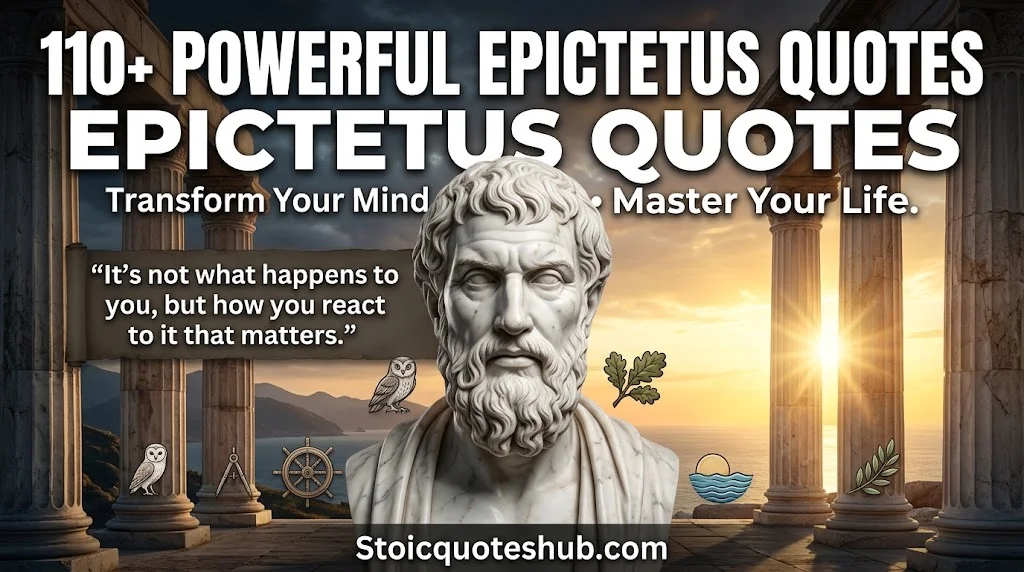
Epictetus was born a slave, yet he taught that true freedom lives inside you. His words have calmed soldiers, leaders, and everyday people for nearly 2,000 years.
Below are 110+ Stoic Quotes from Epictetus with their sources and a short note on what each one means. Use them to build a calmer mind and a stronger life.
Table of Contents
Who Was Epictetus? The Stoic Philosopher Behind These Quotes
Epictetus (about 50–135 AD) was a Greek Stoic philosopher who rose from slavery to teach in Rome. Knowing his story makes his words hit harder.
He was born in Hierapolis, in present-day Turkey. His owner, Epaphroditus, a freed slave in Nero’s court, let him study under the Stoic teacher Musonius Rufus. After he gained his freedom, he taught in Rome. Around 93–95 AD, Emperor Domitian banished the philosophers, so he moved to Nicopolis in Greece and opened a school. Ancient sources say he was lame, and some say a harsh master broke his leg.
Epictetus wrote nothing himself. His student Arrian recorded his talks. Two works survive:
- The Discourses: Four of the original eight books remain.
- The Enchiridion: A short handbook of 53 chapters. The word means “within reach.”
His ideas reached far. Marcus Aurelius quotes him in the Meditations. U.S. Navy Vice Admiral James Stockdale studied the Enchiridion and later credited it for helping him endure more than seven years as a prisoner of war in Vietnam. Psychologist Albert Ellis also named Epictetus as an inspiration for rational emotive behavior therapy, a forerunner of modern cognitive therapy.
How to read these quotes: Translations differ, and many online lines are short paraphrases. This list uses short, widely used wordings, mostly from the public-domain translations of Elizabeth Carter and George Long. Read them in full at MIT Classics and in the Discourses. For deeper study, see the Stanford Encyclopedia of Philosophy entry.
Powerful Epictetus Quotes on Control, Emotions & Mindset
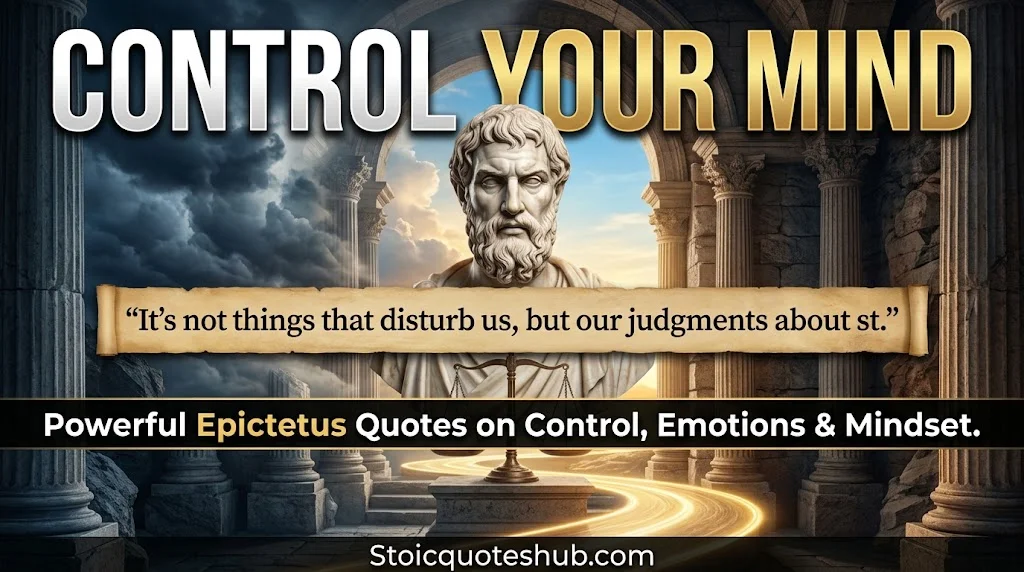
These Stoic quotes from Epictetus tackle the core skill of Stoicism: separating what you control from what you don’t.
Control and Choice
- “Some things are in our control and others are not.” (Enchiridion 1) This is the dichotomy of control, the base of Stoicism.
- “Make the best use of what is in your power, and take the rest as it happens.” (Discourses I.1) Act on what you can. Let go of the rest.
- “Sickness is an impediment to the body, but not to the will.” (Enchiridion 9) Your body may fail, but your inner choice stays free.
- “Lameness is an impediment to the leg, but not to the will.” (Enchiridion 9) Epictetus lived this line.
- “You may fetter my leg, but not even Zeus can overpower my will.” (Discourses I.1) Nobody can force your moral choice.
- “Demand not that events happen as you wish; wish them to happen as they do.” (Enchiridion 8) Acceptance is the start of peace.
- “The more we value things outside our control, the less control we have.” Chasing externals turns you into their servant.
- “There is only one way to happiness: cease worrying about things beyond the power of our will.” Worry only about what you can change.
- “Things outside your control are nothing to you.” (Discourses I.30) See them as neutral, not as threats.
- “Impressions strike us unasked, but agreeing with them is up to us.” You can’t stop a first thought. You can test it.
Judgment and Perception
- “Men are disturbed, not by things, but by the views they take of them.” (Enchiridion 5) Opinion, not the event, stirs up pain.
- “It is not he who reviles you who insults you, but your opinion that he insults you.” (Enchiridion 20) Words sting only when you accept them.
- “You are but an appearance, and not at all what you seem to be.” (Enchiridion 1) Say this to a harsh thought.
- “It is impossible for a man to learn what he thinks he already knows.” (Discourses II.17) Humility keeps the mind open.
- “Understand what your words mean, then speak.” (Discourses III.23) Clear words come from clear thinking.
- “When you take in hand any act, remind yourself what kind of act it is.” (Enchiridion 4) Picture the whole task before you start.
- “If evil is spoken of you and it is true, correct yourself; if it is a lie, laugh at it.” Learn from fair critique. Shrug off the false.
- “He did what seemed right to him.” (Enchiridion 42) People act from their own beliefs, not to spite you.
- “Every soul is deprived of the truth against its will.” (Discourses I.28, quoting Plato) Most wrongdoers are mistaken, not evil.
Emotions, Fear and Anger
- “Death is nothing terrible; the terror lies in our idea of death.” (Enchiridion 5) Fear comes from judgment, not from death itself.
- “I cannot escape death, but I can escape the fear of it.” (Discourses I.27) You can drop the dread.
- “If you do not want to be hot-tempered, do not feed the habit.” (Discourses II.18) Anger grows with practice, so starve it.
- “If you gain time and delay, you will more easily command yourself.” (Enchiridion 20) Pause before you answer.
- “Passions arise from desires that go unmet.” (Discourses I.27) Lower the demand and the storm eases.
- “It is not what happens to you, but how you react that matters.” This is a modern paraphrase of Enchiridion 5. Your response is your real power.
- “Pain is a mask of terror; look beneath it.” (Discourses II.1) Look closely and pain loses force.
- “When you are annoyed, remember it is your own opinion that annoys you.” (Enchiridion 20) Find the thought behind the feeling.
- “Let death and exile be daily before your eyes.” (Enchiridion 21) Facing loss in advance shrinks petty fears.
- “Never say ‘I have lost it,’ only ‘I have returned it.'” (Enchiridion 11) Reframe loss as giving back.
Happiness and Inner Peace
- “Wealth consists not in having great possessions, but in having few wants.” Contentment beats collecting.
- “No man is free who is not master of himself.” Self-mastery is the base of freedom.
- “Freedom is not won by satisfying desire, but by removing it.” (Discourses IV.1) Wanting less makes you freer.
- “Happiness and yearning for what is absent cannot live together.” Gratitude and craving can’t share a room.
- “This is the price of tranquility.” (Enchiridion 12) A small loss buys peace of mind.
- “If you want anything good, get it from yourself.” Inner resources never run out.
- “The essence of philosophy is that a man should live so that his happiness depends as little as possible on external things.” Build inner independence.
- “Be not elated at any excellence that is not your own.” (Enchiridion 6) Take pride in your choices, not your luck.
- “If you wish to be a writer, write.” Doing beats planning.
- “No one is ever unhappy because of someone else.” Your reaction, not their act, makes the pain.
- “On a voyage, enjoy the shells, but keep your mind on the ship.” (Enchiridion 7) Enjoy small pleasures without losing your goal.
Self-Mastery and Freedom
- “Only the educated are free.” (Discourses II.1) Freedom needs wisdom, not just status.
- “We should not moor a ship with one anchor, or our life with one hope.” Keep more than one hope.
- “He is master of every man who has power over what that man wishes or fears.” (Enchiridion 14) Cut the desire and you cut the leash.
- “Practice yourself in little things, and then proceed to greater.” (Discourses IV.1) Build self-discipline in small steps.
- “All philosophy lies in two words: sustain and abstain.” Endure what you must. Refrain from what you should.
- “It is the nature of the wise to resist pleasures, but the foolish to be slaves to them.” Choose your pleasures. Don’t let them choose you.
- “Think of both times: the time of enjoyment and the time of regret.” (Enchiridion 34) Look past the thrill.
- “Behave in life as at a banquet.” (Enchiridion 15) Take what is offered, politely. Don’t grab.
- “Remember that you are an actor in a play, and the author chooses the part.” (Enchiridion 17) Play your role well.
- “Prescribe a character for yourself, to keep alone and in company.” (Enchiridion 33) Be the same in public and in private.
- “Know first who you are, then adorn yourself accordingly.” (Discourses III.23) Identity guides action.
- “Every habit and faculty is increased by its matching actions.” (Discourses II.18) Repeat a thing and it grows stronger.
- “To make anything a habit, do it; to not make it a habit, do not do it.” Habits follow actions.
- “Whatever rules you set for yourself, abide by them as laws.” (Enchiridion 50) Keep your promises to yourself.
- “He who laughs at himself never runs out of things to laugh at.” Light humor protects the ego.
- “No one will compel you if you hold to what is truly your own.” (Enchiridion 1) Clear ownership gives freedom.
Best Stoic Quotes from Epictetus on Life, Adversity & Character
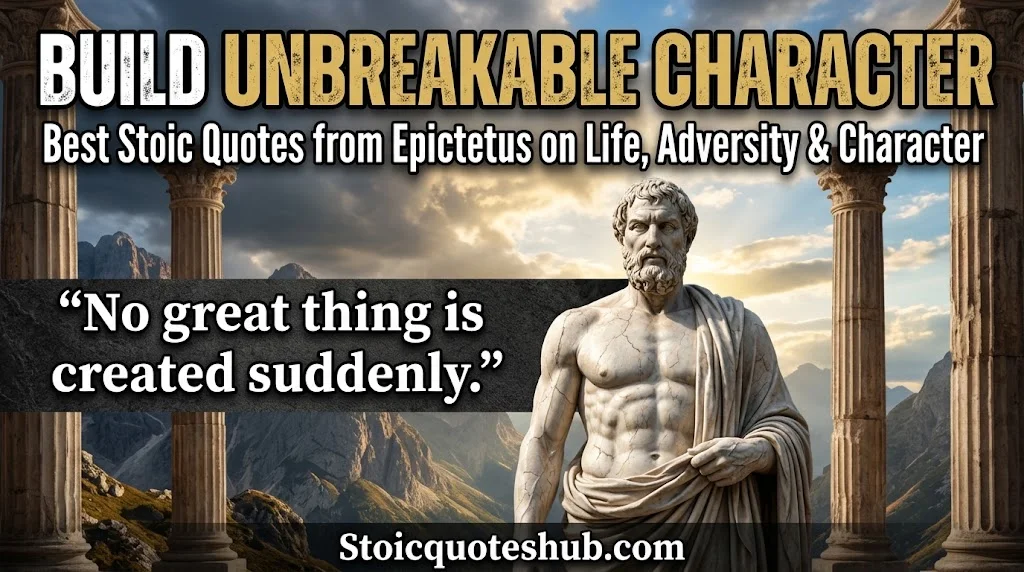
Here are the best Epictetus quotes about life, grouped by the challenges most of us face. Each one points to a practical step.
Adversity and Resilience
- “Difficulties are things that show a person what they are.” (Discourses I.24) Trouble reveals character.
- “Circumstances don’t make the man; they only reveal him.” Hard times expose what was already there.
- “A boxer gains most from his sparring partner.” (Discourses III.20) Rivals and critics train your patience.
- “Think of trouble as a trainer who has matched you with a tough wrestler.” (Discourses I.24) Hardship is practice.
- “Skillful pilots gain their reputation from storms.” Calm seas teach little.
- “Is there smoke in the house? If it is bearable, I stay. If not, I leave.” (Discourses I.25) You always have options.
- “What would Hercules have been without the lion?” (Discourses I.6) Hardship makes heroes.
- “Does this misfortune stop you from being just, brave, and wise?” Ask what trouble can’t touch.
- “If you lose a thing but gain something better, do not say you suffered a loss.” (Discourses IV.3) Count the trade.
Discipline and Daily Progress
- “Progress is not achieved by luck, but by working on yourself daily.” Small steps add up.
- “How long will you wait before you demand the best of yourself?” (Enchiridion 51) Today is a fine day to start.
- “The Olympic Games have begun; you can wait no longer.” (Enchiridion 51) Every day is the match.
- “Nothing great is created suddenly, not even a bunch of grapes or a fig.” (Discourses I.15) Growth takes time.
- “Consider what comes before and after, then begin.” (Enchiridion 29) Plan with the full cost in mind.
- “If you did not learn these things to practice them, why did you learn them?” (Discourses I.29) Knowledge needs action.
- “Sheep do not bring up their grass to show how much they ate.” (Enchiridion 46) Show learning through actions, not talk.
- “On no occasion call yourself a philosopher.” (Enchiridion 46) Live it. Don’t lecture.
- “If you want to improve, be content to be thought foolish.” (Enchiridion 13) Ego blocks progress.
- “The beginning of philosophy is knowing your own weakness.” (Discourses II.11) Honest checks start growth.
- “Each person tends their own field; I tend my own improvement.” (Discourses III.5, citing Socrates) Practice daily self-examination.
Character and Integrity
- “Do not sell your integrity cheap.” (Discourses I.2) Know your price, and set it high.
- “Someone bathes in haste; don’t say he bathes badly, but in haste.” (Enchiridion 45) Judge facts, not motives.
- “What belongs to you? The right use of impressions.” (Enchiridion 6) Your character lives in how you respond.
- “Guard your character as you guard your steps against a nail.” (Enchiridion 38) Small slips cause real injury.
- “Do not think that a person with prestige must be happy.” (Enchiridion 19) Status is not joy.
- “‘I am richer than you, therefore better’ makes no sense.” (Enchiridion 44) Wealth is not worth.
- “If you want to be a man of honor, who is going to stop you?” (Discourses II.2) Honor is your own choice.
- “He did not know my other faults, or he would not have named only these.” (Enchiridion 33) Answer criticism with calm humor.
- “Each role suggests the duties that go with it.” (Discourses II.10) Think: what does a parent, friend, or citizen do?
Death, Fear and Acceptance
- “I must die. Must I die lamenting?” (Discourses I.1) Even endings can be faced with calm.
- “Death is a bogeyman; turn it over and see it doesn’t bite.” (Discourses II.1) Fear shrinks under study.
- “You are a little soul carrying around a corpse.” (quoted by Marcus Aurelius) A blunt reminder to value the mind.
- “Remember how you feel when the same loss strikes another.” (Enchiridion 26) This builds perspective in grief.
Relationships and People
- “If your brother wrongs you, remember that he is your brother.” (Enchiridion 43) Hold the bond.
- “Every matter has two handles, one by which it can be carried and one by which it cannot.” (Enchiridion 43) Pick the handle that works.
- “Keep company only with people who uplift you.” Your circle shapes your habits.
- “Be silent for the most part; speak only what is needed, and briefly.” (Enchiridion 33) Short talk, strong words.
- “We have two ears and one mouth so we can listen twice as much as we speak.” This is widely attributed to him.
- “Do not talk about gladiators, horses, or food; above all, do not gossip.” (Enchiridion 33) Talk about what matters.
- “Treat the unenlightened with sympathy; they err about what matters most.” (Discourses II.22) Compassion beats contempt.
- “A guide shows the lost the right road; he doesn’t mock them.” (Discourses II.12) Teach, don’t shame.
- “In prosperity it is easy to find a friend; in adversity it is the hardest.” Real friends stay.
- “Where is friendship found, if not in fairness, loyalty, and virtue?” (Discourses II.22) Trust grows from integrity.
- “I am a citizen of the world.” (Discourses I.9, echoing Socrates) Care beyond borders.
Wealth, Desire and Contentment
- “Leave your sons well instructed rather than rich.” Wisdom outlasts money.
- “Whoever does not regard what he has as ample wealth is unhappy, though he rule the world.” Enough is a mindset.
- “Material things are indifferent; our use of them is not.” (Discourses II.5) Money is a tool.
- “Someone is honored above you? Did you pay the price they paid?” (Enchiridion 25) Effort buys rewards.
Learning, Wisdom and Action
- “Before measuring grain, settle on a measure.” (Discourses I.17) Clear tools make clear thinking.
- “There must be a science of living well, just as there is of writing or music.” (Discourses IV.1) Living well is a skill you can train.
- “The raw material of the good man is his own mind.” (Discourses III.3) Tend it like a craftsman.
- “What illusion about myself do I entertain?” (Discourses II.21) A strong nightly question.
- “Reason is the faculty that examines all others.” (Discourses I.1) Use it on your own thoughts.
- “No one can force you to agree to what seems wrong.” (Discourses III.22) Your assent is yours.
- “Lead me, Zeus, and Destiny, wherever you have assigned me.” (Enchiridion 53, from Cleanthes) A prayer of trust and acceptance.
- “Anytus and Meletus can kill me, but they cannot harm me.” (Enchiridion 53, from Socrates) Real harm is losing your character.
Epictetus reminds us that true strength begins with mastering our thoughts and responses. For more timeless wisdom to build resilience, confidence, and inner peace, explore these powerful Stoic quotes for motivation and strength.
How to Use Epictetus’s Stoic Wisdom in Daily Life

Quotes only help when you act on them. These simple steps come straight from Stoic practice.
Use the pause method. When you feel angry or afraid, stop and say, “You are just an impression” (Enchiridion 1). Then ask: Is this in my control? If yes, act. If no, let it go.
Sort your worries. Take a page and draw two columns: “Up to me” and “Not up to me.” Work, money, family, and social media feel messy until you sort them. Spend effort only on the first column.
Review your day at night. Ask three questions: What did I handle well? Where did I react badly? What will I try tomorrow? The Stoics used this evening review for self-improvement.
Try these journal prompts:
- What upset me today, and what was my opinion about it?
- What did I try to control that was never mine?
- Which quote will I practice tomorrow?
Start reading in the right order. Begin with the short Enchiridion. Then move to the Discourses. Pair them with Seneca and Marcus Aurelius for a full view of Stoic philosophy.
FAQs
What are the most powerful Stoic quotes from Epictetus?
The strongest ones teach control, choice, and resilience. Examples include “Some things are in our control and others are not,” “Men are disturbed, not by things, but by the views they take of them,” and “Difficulties are things that show a person what they are.”
What did Epictetus say about controlling your emotions?
He taught that emotions come from our judgments, not from events. He urged a pause before reacting: if you gain time, you will more easily command yourself. He also said not to feed anger, because every habit grows with repeated action.
What are the best Epictetus quotes about life?
Top picks include “Make the best use of what is in your power, and take the rest as it happens,” “Progress is not achieved by luck, but by working on yourself daily,” and “How long will you wait before you demand the best of yourself?”
What did Epictetus say about happiness?
He said happiness comes from inner freedom, not outside things. Peace grows when you stop worrying about what you can’t control and want less. He also held that wealth lies in having few wants, not great possessions.
What are the most famous quotes by Epictetus?
The best known are “Men are disturbed, not by things, but by the views they take of them,” “No man is free who is not master of himself,” and “Wealth consists not in having great possessions, but in having few wants.”
Conclusion
Epictetus gave us a simple rule: control your choices and release the rest. Pick one quote from this list, practice it for a week, and watch your mindset change. Real freedom starts the moment you decide how to respond.

Danish Abroy is a writer and contributor at Stoic Quotes Hub, where he explores timeless ideas from Stoic philosophy and their relevance to modern life. His work focuses on meaningful quotes, practical wisdom, resilience, self-discipline, and developing a calmer perspective in everyday situations.