Most stress starts in the mind, not in the event. In 2025, 75% of U.S. adults said they feel more stressed about the country’s future than they used to, according to the American Psychological Association. Ancient Stoics offered a simple fix: train your mind like a muscle.
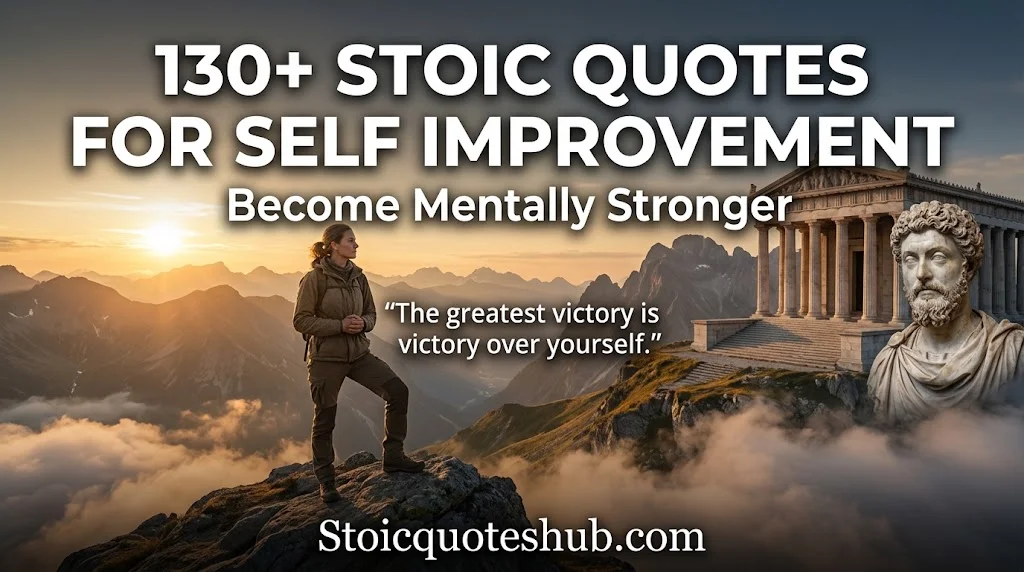
Below are 130+ Stoic quotes on self improvement from Marcus Aurelius, Epictetus, Seneca, Zeno, Cleanthes and Musonius Rufus. Each group comes with a short meaning and one easy step. Wording changes between translations, so you may see small differences elsewhere.
Table of Contents
Best Stoic Quotes on Self Improvement for Daily Growth

These self improvement quotes focus on daily habits, action and honest self-review. Start here if you want small steps that add up.
Epictetus on habits and practice
- “First say to yourself what you would be; then do what you have to do.” — Discourses
- “If you want to improve, be content to be thought foolish and stupid.” — Enchiridion
- “If you wish to be a writer, write.” — Discourses
- “Every habit and capacity is confirmed and grows by the matching actions.” — Discourses
- “Practice yourself in little things, then move on to greater.” — Fragments
- “No great thing is created suddenly.” — Discourses
- “The beginning of philosophy is to know the state of your own mind.” — Discourses
- “It is impossible to learn what you think you already know.” — Discourses
- “Know first who you are, then dress yourself accordingly.” — Discourses
- “Adopt new habits, and put your principles into practice.” — Discourses
- “Before you act, remind yourself what kind of act it is.” — Enchiridion
- “Bear and forbear.” — Epictetus
- “Only the educated are free.” — Discourses
- “Do not be elated at any excellence that is not your own.” — Enchiridion
- “To blame yourself shows your education has begun.” — Enchiridion
What it means: Habits shape who you become. A well-known study from University College London found a new habit took 66 days to form on average. The range ran from 18 to 254 days.
Marcus Aurelius on action and focus
- “Waste no more time arguing what a good man should be. Be one.” — Meditations
- “Look within. Within is the fountain of good.” — Meditations
- “Confine yourself to the present.” — Meditations
- “When you rise unwillingly, think: I am rising to do a human being’s work.” — Meditations
- “Do every act as if it were your last, without aimlessness.” — Meditations
- “Remember how long you have been putting things off.” — Meditations
- “The impediment to action advances action.” — Meditations
- “The art of living is more like wrestling than dancing.” — Meditations
- “Most of what we say and do is not necessary. Drop it, and you gain time and calm.” — Meditations
- “When you fail, return to the task and do not lose heart.” — Meditations
- “If anyone can show me I am wrong, I will gladly change.” — Meditations
- “To change your mind and follow someone who corrects you is still freedom.” — Meditations
- “Do not be ashamed to be helped.” — Meditations
- “Do not waste what remains of your life thinking about other people.” — Meditations
- “Do not indulge in dreams of what you do not have.” — Meditations
What it means: Stop planning to be better and start acting. Marcus wrote these lines for himself, as private notes. That makes them honest.
Try this: Write one thing you will do today, and do it before noon.
Seneca and Zeno on time and self-review
- “While we are postponing, life speeds by.” — Moral Letters
- “Begin at once to live.” — Moral Letters
- “What bad habit have you cured today? What fault have you resisted?” — On Anger
- “I daily plead my case before myself.” — On Anger
- “Associate with those who will make a better person of you.” — Moral Letters
- “If a person does not know which port they sail to, no wind is favorable.” — Moral Letters
- “Our plans miscarry because they have no aim.” — Moral Letters
- “To be everywhere is to be nowhere.” — Moral Letters
- “Philosophy teaches us to act, not to speak.” — Moral Letters
- “Retire into yourself, as far as you can.” — Moral Letters
- “Life is long if you know how to use it.” — On the Shortness of Life
- “It is not that we have a short time to live, but that we waste a lot of it.” — On the Shortness of Life
- “Sometimes even to live is an act of courage.” — Moral Letters
- “We learn not for school, but for life.” — Moral Letters
- “Men learn while they teach.” — Moral Letters
- “We have two ears and one mouth, so we should listen more than we speak.” — Zeno of Citium
What it means: Seneca reviewed his day each night. This is the original evening reflection, and it builds self-awareness.
Stoic Quotes on Self Improvement for Mental Strength
Mental strength in Stoicism means a calm mind under pressure. These quotes cover the dichotomy of control, resilience, anger and adversity.
Epictetus on control
- “Some things are up to us, and some are not.” — Enchiridion
- “People are disturbed not by things, but by the views they take of them.” — Enchiridion
- “Make the best use of what is in your power, and take the rest as it happens.” — Discourses
- “Do not seek for events to happen as you wish; wish for them to happen as they do.” — Enchiridion
- “Difficulties show what people are made of.” — Discourses
- “Freedom comes from controlling desire, not from satisfying it.” — Discourses
- “Never say ‘I have lost it.’ Say ‘I have given it back.'” — Enchiridion
- “Remember that you are an actor in a play, and you did not choose the part.” — Enchiridion
- “The wise person does not grieve for what they lack, but enjoys what they have.” — Fragments
- “The chief task in life is to separate what is outside my control from what is my choice.” — Discourses
- “The wise look to themselves, not to outside things, for help and harm.” — Enchiridion
- “When told that someone speaks ill of you, say: he did not know my other faults.” — Enchiridion
- “Whoever wishes to be free should not wish for, or avoid, what depends on others.” — Enchiridion
- “It is not the person who insults you that harms you, but your opinion of the insult.” — Enchiridion
- “Sickness is an impediment to the body, but not to the will.” — Enchiridion
What it means: This is the dichotomy of control. You control your thoughts, choices and actions. You do not control the weather, traffic or other people’s opinions.
Try this: When stress hits, write two lists: “mine” and “not mine.” Act only on the first.
Marcus Aurelius on calm and perspective
- “Nowhere can a person find a quieter retreat than in their own soul.” — Meditations
- “The mind free from passions is a fortress.” — Meditations
- “Be like the headland on which the waves constantly break.” — Meditations
- “Nothing happens to anyone that they are not formed by nature to bear.” — Meditations
- “Things themselves do not touch the soul.” — Meditations
- “Take away the opinion, and the complaint ‘I have been harmed’ is gone.” — Meditations
- “If anything outside pains you, it is your judgment of it that pains you, and you can wipe that out.” — Meditations
- “How much more grievous are the consequences of anger than its causes.” — Meditations
- “Whatever happens at all happens as it should.” — Meditations
- “Accept the things to which fate binds you.” — Meditations
- “Do not disturb yourself by picturing your whole life at once.” — Meditations
- “The universe is change; life is opinion.” — Meditations
- “Loss is nothing but change.” — Meditations
- “The best revenge is not to be like your enemy.” — Meditations
- “No one loses any life but the one they now live.” — Meditations
- “Let not future things disturb you; you will meet them with the same reason you use today.” — Meditations
What it means: Your inner peace does not depend on events. Marcus led an empire through war and plague, and he used these ideas to stay steady.
Try this: Before you react, pause for one slow breath. Ask: “Is this the event, or my judgment of it?”
Seneca and others on hardship
- “We suffer more often in imagination than in reality.” — Moral Letters
- “He suffers more than necessary who suffers before it is necessary.” — Moral Letters
- “Fire tests gold; misfortune tests the brave.” — On Providence
- “I judge you unfortunate because you have never lived through misfortune.” — On Providence
- “The greatest remedy for anger is delay.” — On Anger
- “Some wise people have called anger a brief madness.” — On Anger
- “He who is brave is free.” — Moral Letters
- “Fate leads the willing and drags the unwilling.” — Moral Letters
- “Difficulties strengthen the mind, as labor does the body.” — Seneca
- “We are more often frightened than hurt.” — Moral Letters
- “Let us prepare our minds as if we had come to the very end.” — Seneca
- “The wise person is self-sufficient.” — Moral Letters
- “Calamity is virtue’s opportunity.” — On Providence
- “It matters not what you bear, but how you bear it.” — Seneca
- “Set aside days to practice with the plainest food and roughest clothes.” — Moral Letters
What it means: Seneca practiced mild hardship on purpose. Modern therapists use a similar idea in cognitive behavioral therapy. Albert Ellis, who helped found it, credited Epictetus as an influence.
Try this: Take one cold shower or skip one comfort today. Notice that you are fine.
Self-improvement becomes even more powerful when you learn to apply Stoic principles to everyday challenges. For deeper wisdom on mastering your thoughts and strengthening your mindset, explore these powerful Epictetus Stoic quotes.
Stoic Quotes for Personal Growth and Becoming a Better Person

Stoics saw personal growth as building character and virtue. These quotes cover kindness, time, role models and a growth mindset.
Marcus Aurelius on character
- “It is peculiar to humans to love even those who do wrong.” — Meditations
- “What is not good for the swarm is not good for the bee.” — Meditations
- “A person should be upright, not kept upright.” — Meditations
- “Where a person can live, there they can live well.” — Meditations
- “Perfection of character is to live each day as if it were your last.” — Meditations
- “Do not act as if you had ten thousand years to live.” — Meditations
- “Very little is needed to make a happy life.” — Meditations
- “The soul is dyed by the color of its thoughts.” — Meditations
- “Think of what you have, not only of what you lack.” — Meditations
- “If it is not right, do not do it; if it is not true, do not say it.” — Meditations
- “You may depart from life this very moment; let that guide what you do and say.” — Meditations
- “The wrongdoer is related to me, not by blood, but by mind.” — Meditations
- “We were born to work together, like feet, hands and eyelids.” — Meditations
- “Do good like a vine that bears grapes, and ask for nothing back.” — Meditations
- “Be neither careless in deeds, nor confused in words, nor rambling in thought.” — Meditations
- “Whatever anyone does or says, I must be good.” — Meditations
- “A person’s worth is the worth of what they care about.” — Meditations
What it means: Character is built in small choices. Virtue means wisdom, courage, justice and self-control, the four Stoic virtues.
Try this: Choose one virtue this week. Write one way to practice it each day.
Epictetus and Cleanthes on becoming your best
- “Set up for yourself a model of character, in private and in public.” — Enchiridion
- “Let silence be your general rule; say only what is needed.” — Enchiridion
- “Do not close your eyes at night until you have reviewed the day’s deeds.” — Discourses
- “Where did I go wrong? What did I do? What duty did I leave undone?” — Discourses
- “How long will you wait before you demand the best of yourself?” — Enchiridion
- “You are no longer a child, but a full-grown adult.” — Enchiridion
- “Let what seems best be a law you never break.” — Enchiridion
- “It is better to act rightly most of the time and admit your errors.” — Fragments
- “Lead me, Zeus, and you, Destiny, wherever you have assigned me.” — Cleanthes
What it means: Epictetus was born enslaved. Even so, he taught that no one can take away your choices. A role model can help you see what to copy.
Try this: Name one person you admire. Write the one habit you want to borrow.
Seneca, Zeno and Musonius Rufus on a good life
- “I was not born for one corner; the whole world is my country.” — Moral Letters
- “Wherever there is a human being, there is a chance for kindness.” — On the Happy Life
- “It is not the person who has too little, but the one who craves more, that is poor.” — Moral Letters
- “You live as if you were destined to live forever.” — On the Shortness of Life
- “It takes the whole of life to learn how to live.” — On the Shortness of Life
- “Live among people as if God beheld you.” — Moral Letters
- “Whatever can happen at any time can happen today.” — Seneca
- “A happy life is one in harmony with its own nature.” — On the Happy Life
- “Choose someone you admire and keep them before your eyes.” — Moral Letters
- “One who receives a benefit with gratitude repays the first installment.” — On Benefits
- “No one can wear a mask for long.” — On Clemency
- “If you wish to be loved, love.” — Moral Letters
- “Wealth is the slave of the wise and the master of a fool.” — On the Happy Life
- “Well-being is realized by small steps, but is truly no small thing.” — Attributed to Zeno
- “A friend is another self.” — Attributed to Zeno
- “Humans are born with an inclination toward virtue.” — Musonius Rufus
What it means: The Stoics linked growth to service. A better you also helps others. Stoicism began with Zeno of Citium in Athens around 300 BC, as the Stanford Encyclopedia of Philosophy explains.
Try this: Do one small kind act today. Do not tell anyone.
FAQs
What are the best Stoic quotes on self improvement?
Top picks include “Waste no more time arguing what a good man should be. Be one.” (Marcus Aurelius), “First say to yourself what you would be; then do what you have to do.” (Epictetus), and “While we are postponing, life speeds by.” (Seneca). All three push you toward action.
How can Stoic quotes help with self improvement?
They give short, clear prompts for daily choices. A quote can remind you to pause, focus on what you control and act with purpose. Read one each morning. Then ask how it applies to your day.
What do Stoics say about becoming a better person?
Stoics say you improve through daily practice of virtue: wisdom, courage, justice and self-control. They urge you to review your day, learn from mistakes and follow good role models. Progress comes from small, steady actions, not big promises.
What is the best Stoic quote for personal growth?
Many pick Epictetus: “If you want to improve, be content to be thought foolish and stupid.” It means growth needs humility. You must accept being a beginner and let go of the need to look smart.
How can Stoicism improve your mindset?
Stoicism trains you to split what you control from what you don’t. This cuts worry and builds calm. You respond to events with reason instead of habit. Over time, this builds mental resilience and a steadier mindset.
Conclusion
These Stoic quotes on self improvement are tools, not decoration. Each one points to the same idea: you cannot control life, but you can shape your response.
Pick one quote today. Use it for seven days. Then pick another, and keep building your mental strength.

Danish Abroy is a writer and contributor at Stoic Quotes Hub, where he explores timeless ideas from Stoic philosophy and their relevance to modern life. His work focuses on meaningful quotes, practical wisdom, resilience, self-discipline, and developing a calmer perspective in everyday situations.