

Stoic quotes on kindness prove that a calm mind can still have a warm heart. Marcus Aurelius, Seneca, and Epictetus all taught that kindness is a duty, not a weakness.
This guide shares their best Stoic quotes about kindness, what they mean, and how to use them. Each quote is tied to its source, so you can trust it.
Table of Contents
Stoic Quotes on Kindness From Marcus Aurelius, Seneca & Epictetus

These three men wrote the core texts of Stoicism. Their words on compassion and kindness are still among the most quoted today.
Marcus Aurelius on kindness (Meditations)
- “Love mankind.” (7.31)
- “Men exist for the sake of one another. Teach them then, or endure them.” (8.59)
- “The best way of avenging thyself is not to become like the wrong-doer.” (6.6)
- “We are made for cooperation, like feet, like hands, like eyelids.” (2.1)
- “All things are implicated with one another, and the bond is holy.” (7.9)
- “What is not good for the swarm is not good for the bee.” (6.54)
- “Whatever any man does or says, I must be good.” (7.15)
- “Nor can I be angry with my kinsman, nor hate him.” (2.1)
- “Kindness is unconquerable, so long as it is without flattery or hypocrisy.” (11.18, wording varies by translation)
Marcus saw kindness as part of human design. We are social creatures, so harming others harms the whole.
Seneca on kindness (Letters, On Anger, On the Happy Life)
- “Wherever there is a human being, there is an opportunity for a kindness.” (On the Happy Life 24)
- “As long as we are among human beings, let us cherish humanity.” (On Anger 3.43)
- “No good thing is pleasant to possess, without friends to share it.” (Letter 6)
- “You must live for another, if you wish to live for yourself.” (Letter 48)
- “We are the parts of one great body.” (Letter 95)
Seneca ties kindness to gratitude and generosity. A kind act, in his view, is a shared good.
Epictetus and Zeno on kindness
- “Every thing has two handles, the one by which it may be borne, the other by which it may not.” (Epictetus, Enchiridion 43)
- “It is not he who reviles you or strikes you who insults you, but your opinion that these things are insulting.” (Epictetus, Enchiridion 20)
- “We have two ears and one mouth, so that we may listen more and talk less.” (Zeno of Citium, reported in Diogenes Laertius 7.23)
Many sites credit the last line to Epictetus. Ancient sources credit it to Zeno, the founder of Stoicism.
Short Stoic Quotes About Kindness and Compassion
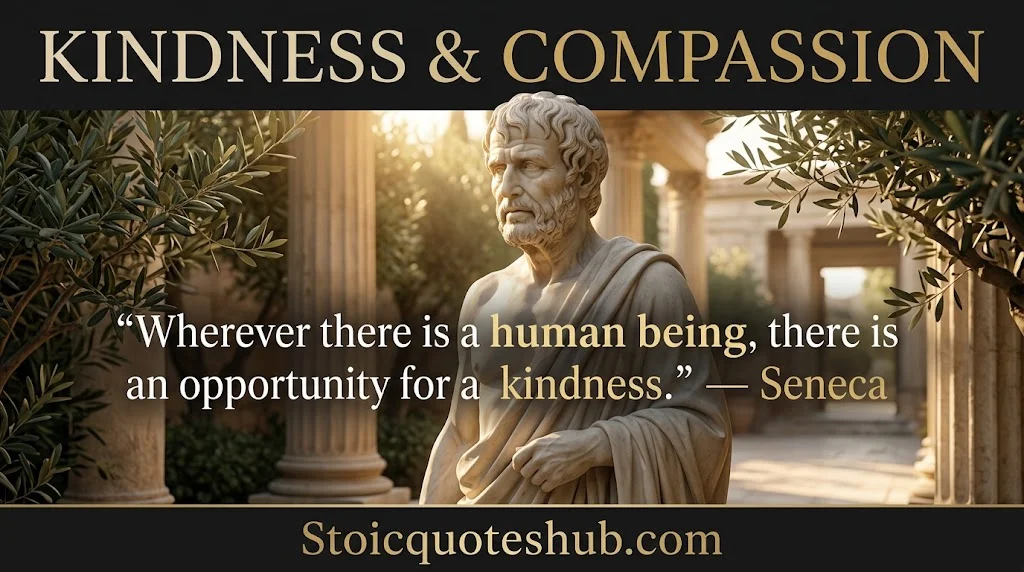
Short lines are easy to remember and share. Use them for journals, cards, captions, or a daily reminder.
Stoic one-liners
- “If you wish to be loved, love.” (Seneca, Letter 9)
- “Love mankind.” (Marcus Aurelius)
- “Men exist for the sake of one another.” (Marcus Aurelius)
- “Cherish humanity.” (Seneca)
Kindness quotes that echo Stoic thought
- “No act of kindness, no matter how small, is ever wasted.” (Aesop)
- “Kindness begets kindness.” (Sophocles)
- “You cannot do a kindness too soon, for you never know how soon it will be too late.” (Ralph Waldo Emerson)
- “Kindness is in our power, even when fondness is not.” (Samuel Johnson)
- “The best portion of a good man’s life: his little, nameless, unremembered acts of kindness and of love.” (William Wordsworth)
- “Gratitude is not only the greatest of virtues, but the parent of all the others.” (Cicero)
- “My religion is very simple. My religion is kindness.” (Dalai Lama)
A quote that is not Stoic. “Be kind, for everyone you meet is fighting a hard battle” is often credited to Plato. It traces back to the Scottish writer Ian Maclaren in 1897. Check the source before you share a quote.
Kindness and compassion help us connect with others, but Stoic philosophy also teaches us how to face life’s hardships with courage and emotional balance. Explore these inspiring Stoic quotes on pain to develop mental strength, overcome suffering, and maintain inner peace during difficult times.
How Stoicism Teaches Kindness: Virtue, Self-Kindness & Boundaries

Stoic kindness is not soft or random. It rests on reason and on the four virtues: wisdom, justice, courage, and temperance.
How do Stoic philosophers define kindness? They treat it as a form of justice and a duty to others. The Stoics called our natural bond with other people oikeiosis, meaning “belonging.” The Stoic Hierocles pictured it as circles of concern: yourself, family, community, and all of humanity. The goal is to draw the outer circles inward.
Pity versus clemency. Seneca warned against pity because it is driven by feeling. He praised clemency because it is driven by reason. A Stoic helps because it is right, not because emotion takes over.
Kindness to difficult people. Epictetus taught that people who wrong us act on a mistaken belief about what is good. That makes patience and empathy the wise response. Marcus began his days by expecting rude, ungrateful, and arrogant people. He chose not to be harmed by them.
Kindness starts with self-control. Your actions are in your control. Other people’s thanks are not. So give without expecting praise or reward, and do not drain your own calm. Saying “no” kindly is also a Stoic act. Kindness is not people-pleasing.
Why it matters. A 2018 meta-analysis of 27 studies with 4,045 participants found a small-to-medium boost in well-being for people who perform acts of kindness. You can read the study in the Journal of Experimental Social Psychology. The effect is modest, so treat kindness as a steady habit, not a cure-all.
How to Practice Stoic Kindness in Daily Life

Stoic kindness is a skill, and daily habits build it. Here is a simple routine.
- Morning: Set one clear intention to be kind. Expect hard people and plan to stay calm.
- During the day: Pause before you react. Listen first. Take the “soft handle” of every problem, as Epictetus advised.
- Small acts: Offer help, give your full attention, or say thank you. Small acts count.
- Evening: Review your day. Seneca describes the philosopher Sextius asking himself each night what flaw he had healed that day. Ask where you were kind and where you could have been kinder.
Real-life examples. At work, answer a sharp email with a calm, clear reply. At home, listen before you defend yourself. Online, skip the pile-on and move on.
FAQs
What are the best Stoic quotes on kindness?
Some of the best are Seneca’s “Wherever there is a human being, there is an opportunity for a kindness” and Marcus Aurelius’s “Love mankind.” Epictetus’s “two handles” saying is also a favorite. Each one links kindness to duty, virtue, and a calm mind.
How do Stoic philosophers define kindness?
They define kindness as acting for the good of others, guided by justice and reason. It comes from our shared human nature, called oikeiosis. It means helping without expecting a reward, and without losing your own calm.
What did Marcus Aurelius say about kindness?
Marcus wrote that people exist for one another, so we should teach them or endure them. He also wrote that the best revenge is not to become like the wrongdoer. For him, kindness meant patience, self-control, and refusing to hate.
What are the most powerful Stoic quotes about compassion?
Seneca’s “As long as we are among human beings, let us cherish humanity” is a strong one. So is “We are the parts of one great body.” Marcus’s line that all things are bound together in a “holy” bond also stands out.
How does Stoicism teach us to be kind to others?
Stoicism teaches kindness through practice. Expect difficult people, pause before you react, and see wrongdoing as a mistake. Give without expecting thanks, and review your day each evening. These habits build compassion and inner peace over time.
Conclusion
Stoic kindness is strong, calm, and rooted in reason. Marcus, Seneca, and Epictetus all taught that we are one human family. Use the quotes above as daily reminders, and keep the habits simple. Over time, small acts of kindness lead to wiser choices and a more peaceful mind.

Danish Abroy is a writer and contributor at Stoic Quotes Hub, where he explores timeless ideas from Stoic philosophy and their relevance to modern life. His work focuses on meaningful quotes, practical wisdom, resilience, self-discipline, and developing a calmer perspective in everyday situations.