Stoic quotes on suffering share one big idea: much of our pain comes from how we judge events, not from the events alone. Below are 131 quotes from Marcus Aurelius, Epictetus, Seneca and other voices, each with a short note on how to use it.
Table of Contents
Best Stoic Quotes on Suffering From Marcus Aurelius, Epictetus & Seneca
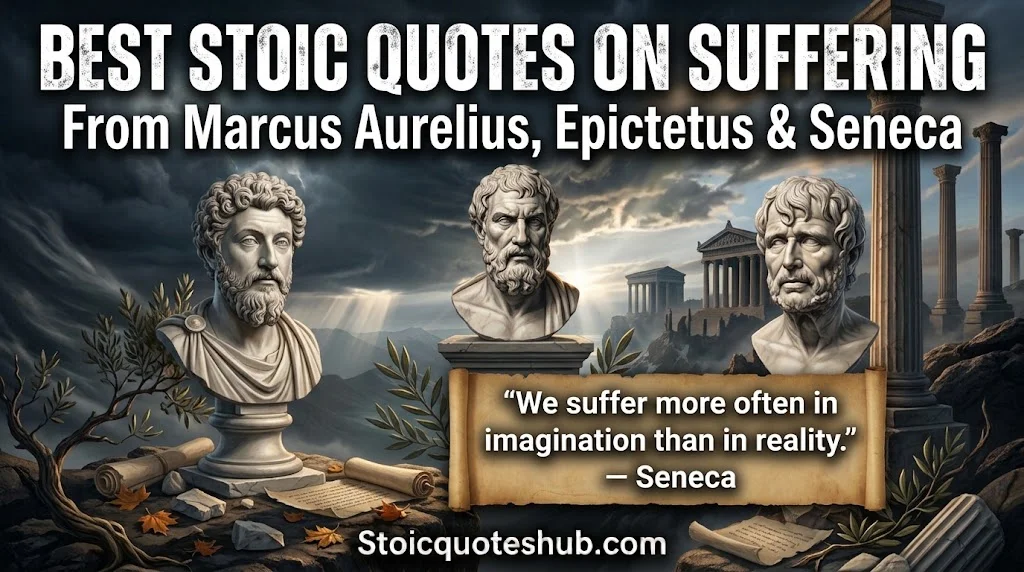
These three men knew real hardship. Epictetus was born enslaved, Seneca was exiled to Corsica, and Marcus Aurelius led Rome through plague and war (Stanford Encyclopedia of Philosophy).
Marcus Aurelius on pain and suffering
- “If thou art pained by any external thing, it is not this thing that disturbs thee, but thy own judgment about it.” — Meditations 8.47. You can’t control events, but you can revise your judgment.
- “Take away thy opinion, and then there is taken away the complaint, ‘I have been harmed.’” — 4.7. No complaint, no sense of harm.
- “Pain is neither intolerable nor everlasting, if thou bearest in mind that it has its limits.” — 7.64. Pain has edges. Remember them.
- “Nothing happens to any man which he is not formed by nature to bear.” — 5.18. You are built for this.
- “Be like the promontory against which the waves continually break.” — 4.49. Stand firm and let the storm pass.
- “I continue free from pain, neither crushed by the present nor fearing the future.” — 4.49. Name your hardship, then name what is still intact.
- “What stands in the way becomes the way.” — 5.20. Obstacles can become the path.
- “The mind which is free from passions is a citadel.” — 8.48. Calm works like a fortress.
- “It is in thy power whenever thou shalt choose to retire into thyself.” — 4.3. Peace is a place you can enter at will.
- “Do not disturb thyself by thinking of the whole of thy life.” — 8.36. Handle today’s piece only.
- “Let not future things disturb thee.” — 7.8. You’ll meet them with the same reason you have now.
- “The soul is dyed by the thoughts.” — 5.16. Thought habits color your mood.
- “Is a cucumber bitter? Throw it away. Are there briars in the road? Turn aside.” — 8.50. Don’t dwell on what you can simply step around.
- “Let it make no difference to thee whether thou art cold or warm, if thou art doing thy duty.” — 6.2. Discomfort shouldn’t change your course.
Epictetus on suffering and the dichotomy of control
- “Men are disturbed, not by things, but by the principles and notions which they form concerning things.” — Enchiridion 5. Your view of the event is the real trigger.
- “Some things are in our control, others not.” — Enchiridion 1. This is the dichotomy of control in seven words.
- “Make the best use of what is in your power, and take the rest as it happens.” — Discourses 1.1.17. Spend energy where it works.
- “Wish the things which happen to be as they are, and you will have a tranquil flow of life.” — Enchiridion 8. Acceptance brings calm.
- “Disease is an impediment to the body, but not to the will.” — Enchiridion 9. Illness limits the body, not your character.
- “Lameness is an impediment to the leg, but not to the will.” — Enchiridion 9. Epictetus spoke from lived experience.
- “I must die. Must I then die lamenting?” — Discourses 1.1. Some things are fixed. Your manner is not.
- “You may fetter my leg, but my will not even Zeus himself can overpower.” — Discourses 1.1. Your will is yours.
- “Difficulties are things that show what men are.” — Discourses 1.24. Hardship reveals character.
- “God, like a trainer of wrestlers, has matched you with a rough young man.” — Discourses 1.24. Treat the struggle as training.
- “Say to every harsh appearance, You are an appearance, and in no manner what you appear to be.” — Enchiridion 1. Pause before you believe the first impression.
- “When we are hindered, or disturbed, or grieved, let us never attribute it to others, but to ourselves.” — Enchiridion 5. Look first at your own judgment.
- “Remember that you are an actor in a drama, of such a kind as the author pleases.” — Enchiridion 17. Play your part well, whatever the role.
- “It is not he who gives ill language who affronts, but the principle which represents these things as insulting.” — Enchiridion 20. An insult only hurts if you agree with it.
- “Nothing great is produced suddenly.” — Discourses 1.15. Resilience grows slowly, like fruit.
Seneca on suffering, fear and endurance
- “We suffer more often in imagination than in reality.” — Letters 13.4. Most pain is rehearsal.
- “There are more things likely to frighten us than there are to crush us.” — Letters 13.4. Fear exaggerates.
- “He suffers more than necessary, who suffers before it is necessary.” — Letters 98.8. Don’t pay for trouble in advance.
- “Some things torment us more than they ought; some torment us before they ought.” — Letters 98.5. Check the timing and the size of your worry.
- “Fire tests gold, misfortune brave men.” — On Providence 5. Hardship proves strength.
- “Calamity is virtue’s opportunity.” — On Providence 4. Trouble gives courage something to do.
- “Nothing is more unhappy than the man to whom no adversity has ever happened.” — On Providence 3. A life without tests builds no strength.
- “Brave men rejoice in adversity, as brave soldiers triumph in war.” — On Providence 4. See the fight as a stage for skill.
- “Those whom He approves, whom He loves, He strengthens, He tests, He disciplines.” — On Providence 4. Seneca saw hardship as training.
- “A pilot is tested in a storm, a soldier on the battlefield.” — On Providence 5. Skill shows under pressure.
- “Sometimes even to live is an act of courage.” — Letters 78.2. Getting through a hard day counts.
- “If pain is long, it is light; if it is severe, it is short.” — Letters 78.7, quoting Epicurus. Intensity and duration trade off.
- “Cease to hope, and you will cease to fear.” — Letters 5.7. Fear and hope are tied together.
- “It is not because things are difficult that we do not dare; it is because we do not dare that they are difficult.” — Letters 104.26. Action shrinks the task.
- “Fate leads the willing, and drags the unwilling.” — Letters 107.11. Fighting reality adds suffering.
- “The greatest hindrance to living is expectancy, which hangs upon tomorrow and loses today.” — On the Shortness of Life 9. Today is where relief starts.
Zeno, Musonius Rufus and Epicurus
- “I made a prosperous voyage when I suffered shipwreck.” — Zeno of Citium, via Diogenes Laërtius 7.5. Zeno’s lost cargo led him to philosophy.
- “If you accomplish something good with hard work, the labor passes quickly, but the good endures.” — Musonius Rufus, Lectures. Effort fades, results stay.
- “Pain does not last continuously in the flesh.” — Epicurus, Principal Doctrines 4. Marcus and Seneca borrowed this thought.
Wording shifts between translations. These quotes come from public-domain texts, which you can check at the MIT Internet Classics Archive and the Enchiridion. Several popular lines are not verbatim ancient quotes. “Suffering arises from trying to control what is uncontrollable” paraphrases Epictetus. “Pain is inevitable, suffering is optional” is modern. “A gem cannot be polished without friction” is often credited to Seneca but isn’t in his surviving works. “To live is to suffer, to survive is to find some meaning in the suffering” is a loose paraphrase often credited to Nietzsche.
Stoic Quotes on Pain, Loss & Adversity to Find Inner Peace
Pain is common. In 2023, 24.3% of U.S. adults had chronic pain, and 8.5% had pain that often limited daily life (CDC). Pick the group below that matches what you’re facing.
Pain and mindset
- “The mind may, by stopping all manner of commerce and sympathy with the body, still retain its own tranquility.” — Marcus Aurelius, 7.33
- “Neither the future nor the past pains thee, but only the present.” — Marcus Aurelius, 8.36
- “Show me a man who, though sick, is happy.” — Epictetus, Discourses 2.19
- “How easy it is to repel and to wipe away every impression which is troublesome.” — Marcus Aurelius, 5.2
- “There is nothing either good or bad, but thinking makes it so.” — Shakespeare, Hamlet
Fear and anxiety about suffering
Fear of pain often hurts more than pain. These lines help you loosen its grip.
- “A man who fears suffering is already suffering from what he fears.” — Michel de Montaigne
- “How ridiculous is he who is surprised at anything which happens in life.” — Marcus Aurelius, 12.13
- “Is this the condition that I feared?” — Seneca, Letters 18.6
- “Death is not terrible, else it would have appeared so to Socrates.” — Epictetus, Enchiridion 5
- “Let death and exile be daily before your eyes.” — Epictetus, Enchiridion 21
- “Wipe out the imagination: check desire: extinguish appetite.” — Marcus Aurelius, 9.7
- “Courage was not the absence of fear, but the triumph over it.” — Nelson Mandela
Grief, loss and heartbreak
The Stoics didn’t ask you to feel nothing. They asked you to grieve without sinking. This is the Stoic way of dealing with loss: feel it, then stay upright.
- “Time is like a river made up of the events which happen.” — Marcus Aurelius, 4.43
- “Is any man afraid of change? What can take place without change?” — Marcus Aurelius, 7.18
- “If you kiss your child, say that you only kiss things which are human.” — Epictetus, Enchiridion 3
- “These are things that will happen.” — Epictetus, Enchiridion 26
- “Never say of any thing, ‘I have lost it;’ but, ‘I have restored it.’” — Epictetus, Enchiridion 11
- “We may weep, but we must not wail.” — Seneca, Letters 63
- “It is better to conquer grief than to deceive it.” — Seneca, Letters 63
- “Do not act as if thou wert going to live ten thousand years.” — Marcus Aurelius, 4.17
- “We are healed of a suffering only by experiencing it to the full.” — Marcel Proust
- “The deeper that sorrow carves into your being, the more joy you can contain.” — Kahlil Gibran
- “We are never so defenseless against suffering as when we love.” — Sigmund Freud
- “Waiting is painful. Forgetting is painful.” — Paulo Coelho
- “Find the ones worth suffering for.” — Bob Marley
- “Suffering passes, while love is eternal.” — Laura Ingalls Wilder
Failure and setbacks
- “We acquire the strength we have overcome.” — Ralph Waldo Emerson
- “The harder the conflict, the more glorious the triumph.” — Thomas Paine
- “If you would improve, be content to be thought foolish.” — Epictetus, Enchiridion 13
- “Far better is it to dare mighty things.” — Theodore Roosevelt
- “No longer talk about the kind of man that a good man ought to be, but be such.” — Marcus Aurelius, 10.16
- “Be not discouraged, if thou dost not succeed in doing everything according to right principles.” — Marcus Aurelius, 5.9
- “The world breaks everyone and afterward many are strong at the broken places.” — Ernest Hemingway
- “You may encounter many defeats, but you must not be defeated.” — Maya Angelou
- “I postpone death by living, by suffering, by error, by risking.” — Anaïs Nin
Adversity and meaning
- “Although the world is full of suffering, it is also full of the overcoming of it.” — Helen Keller
- “Character cannot be developed in ease and quiet.” — Helen Keller
- “Out of suffering have emerged the strongest souls.” — Kahlil Gibran
- “Your pain is the breaking of the shell that encloses your understanding.” — Kahlil Gibran
- “Wisdom comes alone through suffering.” — Aeschylus
- “Suffering becomes beautiful when anyone bears great calamities with cheerfulness.” — Aristotle
- “What does not kill me makes me stronger.” — Friedrich Nietzsche
- “Suffering is an ineradicable part of life, even as fate and death.” — Viktor Frankl
- “The last of the human freedoms—to choose one’s attitude in any given set of circumstances.” — Viktor Frankl
- “We are challenged to change ourselves.” — Viktor Frankl
- “People have a hard time letting go of their suffering.” — Thich Nhat Hanh
- “Nothing is miserable unless you think it so.” — Boethius, Consolation of Philosophy 2
- “Pain and suffering are always inevitable for a large intelligence and a deep heart.” — Fyodor Dostoevsky
- “Neurosis is always a substitute for legitimate suffering.” — Carl Jung
- “Man cannot remake himself without suffering, for he is both the marble and the sculptor.” — Alexis Carrel
- “The reward of suffering is experience.” — Harry S. Truman
- “Suffering is not a punishment—it is a result.” — Robert G. Ingersoll
- “I somehow feel that everything will change for the better.” — Anne Frank
- “Anywhere I see suffering, that is where I want to be.” — Princess Diana
- “Turn our common suffering into hope for the future.” — Nelson Mandela
- “One must choose in life between boredom and suffering.” — Madame de Staël
Suffering can test your ability to remain calm, focused, and in control when life becomes difficult. To strengthen that mindset further, explore these Stoic discipline quotes for self-control, which offer practical wisdom for developing greater discipline and emotional resilience.
How Stoic Quotes on Suffering Build Inner Resilience
A quote only helps if you use it. These habits turn Stoic words into resilience, mental strength and calm.
The evidence is encouraging but limited. In Stoic Week 2018, participants reported a 12% rise in life satisfaction and a 14% drop in negative emotions. Those were self-reports with no control group (Modern Stoicism report). The link to therapy is older: psychologist Albert Ellis credited Epictetus as an inspiration for rational emotive behavior therapy.
Sort what you control
Write two lists: what is up to you, and what isn’t. Then act only on the first.
- “The condition of a vulgar person is that he never expects benefit or hurt from himself, but from externals.” — Epictetus, Enchiridion 48
- “No man has the power to have everything that he wants, but he has the power not to want what he has not.” — Seneca, Letters 123
- “Look within. Within is the fountain of good.” — Marcus Aurelius, 7.59
- “With every accident, ask yourself what abilities you have for making a proper use of it.” — Epictetus, Enchiridion 10
- “Whatever any one does or says, I must be good.” — Marcus Aurelius, 7.15
- “It’s not what you look at that matters, it’s what you see.” — Henry David Thoreau
Start and end the day on purpose
In the morning, name one likely difficulty. At night, review what you handled well and what you’d change. Keep both brief.
- “I am rising to the work of a human being.” — Marcus Aurelius, 5.1
- “Do every act of thy life as though it were the last.” — Marcus Aurelius, 2.5
- “I avail myself of this privilege, and daily plead my case before myself.” — Seneca, On Anger 3.36
- “No man loses any other life than this which he now lives.” — Marcus Aurelius, 2.14
- “Hold every hour in your grasp.” — Seneca, Letters 1
- “Behave in life as at a banquet.” — Epictetus, Enchiridion 15
Zoom out
The view from above shrinks pain to its true size. Picture your problem from the sky, then from ten years ahead.
- “Soon wilt thou have forgotten all things; soon all things will have forgotten thee.” — Marcus Aurelius, 7.21
- “Consider the courses of the stars, as if thou wert going along with them.” — Marcus Aurelius, 7.47
- “Everything is only for a day, both that which remembers and that which is remembered.” — Marcus Aurelius, 4.35
- “No evil can happen to a good man, either in life or after death.” — Plato, Apology
Train for hard days
Practice small discomforts on purpose, such as cold showers, plain meals or silence. Seneca used this to make fear smaller.
- “Life is warfare.” — Seneca, Letters 96
- “The art of life is more like the wrestler’s art than the dancer’s.” — Marcus Aurelius, 7.61
- “How long will you wait before you demand the best for yourself?” — Epictetus, Enchiridion 51
- “True joy is a stern matter.” — Seneca, Letters 23
- “If a man does not know to which port he is sailing, no wind is favorable.” — Seneca, Letters 71
- “He who has a why to live can bear almost any how.” — Friedrich Nietzsche
Accept, then rise
This is amor fati, love of fate. You don’t cheer for the pain. You agree to work with what is real.
- “Love only that which happens to thee and is spun with the thread of thy destiny.” — Marcus Aurelius, 7.57
- “In the midst of winter, I found there was, within me, an invincible summer.” — Albert Camus
- “If there is no struggle, there is no progress.” — Frederick Douglass
- “Every step toward the goal of justice requires sacrifice, suffering, and struggle.” — Martin Luther King Jr.
- “When one door of happiness closes, another opens.” — Helen Keller
Stoic quotes are not a substitute for care. If your suffering feels too heavy to carry, please talk with a doctor or licensed therapist.
FAQs
What are the best Stoic quotes on suffering?
Three of the best known are Seneca’s “We suffer more often in imagination than in reality,” Marcus Aurelius’s “Pain is neither intolerable nor everlasting,” and Epictetus’s “Men are disturbed, not by things, but by the notions which they form concerning things.” Each points to the same thing: your judgment shapes your pain.
How does Stoicism view suffering?
Stoicism treats suffering as a natural part of life, and teaches that much of it comes from our opinions about events. It separates what we control (thoughts, choices, actions) from what we don’t (other people, health, outcomes). Peace comes from working with that line.
What do Stoic philosophers say about pain and suffering?
They say pain is real but limited. Marcus Aurelius told himself that pain has limits and that adding imagination makes it worse. Epictetus said pain may bind the body but not the will. Seneca warned against suffering before it arrives.
How can Stoic quotes on suffering help you overcome difficult times?
They give you a short, repeatable thought to use in the moment. A line like “What stands in the way becomes the way” can break a spiral of worry. Paired with daily habits such as a morning rehearsal and an evening review, they can build steady resilience.
What is the Stoic way of dealing with suffering?
Name what you feel, then ask what is in your control. Act on that part and let go of the rest. Remember that pain has limits. Treat the hardship as training, and turn it into a chance to practice courage, patience and calm.
Conclusion
Stoic quotes on suffering won’t remove pain, but they can change how you carry it. Choose one quote from above, repeat it today, and let it guide a single action. Small, steady practice is how inner resilience is built.

Danish Abroy is a writer and contributor at Stoic Quotes Hub, where he explores timeless ideas from Stoic philosophy and their relevance to modern life. His work focuses on meaningful quotes, practical wisdom, resilience, self-discipline, and developing a calmer perspective in everyday situations.