Happiness, say the Stoics, depends less on what happens to you and more on how you think about it. Here are 150+ Stoic quotes on happiness, each with a source, to help you build inner peace one thought at a time.
Table of Contents
Best Stoic Quotes on Happiness From Marcus Aurelius, Seneca & Epictetus
Three men shaped most Stoic happiness quotes: an emperor, a statesman and a former slave. Zeno of Citium founded the school in Athens around 300 BC and gave it its core idea: happiness is “a good flow of life,” or eudaimonia.
Marcus Aurelius ruled Rome from AD 161 to 180. He wrote Meditations as notes to himself, not as a book.
- “The happiness of your life depends upon the quality of your thoughts.” (a popular paraphrase of Meditations 5.16)
- “Very little is needed to make a happy life; it is all within yourself, in your way of thinking.” (Meditations)
- “The soul becomes dyed with the color of its thoughts.” (Meditations 5.16)
- “If you are distressed by anything external, the pain is not due to the thing itself, but to your estimate of it; and this you have the power to revoke at any moment.” (Meditations 8.47)
- “Perfection of character is this: to live each day as if it were your last, without frenzy, without apathy, without pretense.” (Meditations 7.69)
- “Dwell on the beauty of life.” (Meditations 7.47)
- “Look well into yourself; there is a source of strength which will always spring up if you will always look.” (Meditations 7.59)
- “Accept the things to which fate binds you, and love the people with whom fate brings you together, but do so with all your heart.” (Meditations 6.39)
- “Confine yourself to the present.” (Meditations 7.29)
- “Nothing happens to anyone that he is not fitted by nature to bear.” (Meditations 5.18)
- “Whatever happens at all happens as it should.” (Meditations 4.10)
- “Choose not to be harmed, and you won’t feel harmed.” (Meditations 4.7)
- “Nowhere can a man find a quieter or more untroubled retreat than in his own soul.” (Meditations 4.3)
- “Receive without conceit, release without struggle.” (Meditations 8.33)
- “Through not observing what is in the mind of another a man has seldom been seen to be unhappy; but those who do not observe the movements of their own minds must of necessity be unhappy.” (Meditations 2.8)
- “Do every act of your life as though it were your last.” (Meditations 2.5)
- “Do not set your thoughts on what you lack, but on the best of what you have.” (Meditations 7.27)
- “Be like the promontory against which the waves continually break; but it stands firm and tames the fury of the water around it.” (Meditations 4.49)
- “Loss is nothing else but change, and change is Nature’s delight.” (Meditations 9.35)
- “A cucumber is bitter? Throw it away. There are briars in the path? Turn aside from them. This is enough.” (Meditations 8.50)
Takeaway: Marcus kept returning to one point. Your mindset is the one thing no one can take from you.
Seneca was a Roman statesman and playwright. He wrote his Letters to Lucilius near the end of his life, before Nero forced him to end it in AD 65.
- “A man is as miserable as he thinks he is.” (Letters 78)
- “True happiness is to enjoy the present, without anxious dependence upon the future.” (On a Happy Life)
- “We suffer more often in imagination than in reality.” (Letters 13)
- “Begin at once to live, and count each separate day as a separate life.” (Letters 101)
- “Life is long if you know how to use it.” (On the Shortness of Life 2)
- “It is not that we have a short time to live, but that we waste a lot of it.” (On the Shortness of Life 1)
- “The greatest obstacle to living is expectancy, which hangs upon tomorrow and loses today.” (On the Shortness of Life 9)
- “He suffers more than necessary who suffers before it is necessary.” (Letters 98)
- “Learn how to feel joy.” (Letters 23)
- “True joy is a stern matter.” (Letters 23)
- “That man is happy whose reason recommends to him the whole posture of his affairs.” (On the Happy Life)
- “If one takes away riches from the wise man, one leaves him still in possession of all that is his: for he lives happy in the present, and without fear for the future.” (On the Happy Life)
- “The greatest blessings of mankind are within us and within our reach.” (On the Happy Life)
- “A good character is the only guarantee of everlasting, carefree happiness.” (Seneca)
- “Happy is the man who can endure the highest and lowest fortune.” (Seneca)
- “It is more fitting for a man to laugh at life than to lament over it.” (On Tranquility of Mind 15)
- “Cease to hope, and you will cease to fear.” (Letters 5, quoting Hecato)
- “The mind that is anxious about future events is miserable.” (Letters 98)
- “As is a tale, so is life: not how long it is, but how good it is, is what matters.” (Letters 77)
- “Hold every hour in your grasp.” (Letters 1)
Takeaway: Seneca warns that worry steals joy before trouble even arrives. Live today, and today is enough.
Epictetus was born a slave in what is now Turkey. Emperor Domitian banished him from Rome in AD 93. He lived simply and taught that freedom is an inner state.
- “Men are disturbed not by things, but by the views which they take of them.” (Enchiridion 5)
- “Some things are in our control and others not.” (Enchiridion 1)
- “Seek not that the things which happen should happen as you wish; but wish the things which happen to be as they are, and you will have a tranquil flow of life.” (Enchiridion 8)
- “Try to enjoy the great festival of life.” (Golden Sayings)
- “Remember that you must behave in life as at a banquet.” (Enchiridion 15)
- “If any man is unhappy, let him remember that he is unhappy by reason of himself alone.” (Discourses)
- “The essence of philosophy is that a man should so live that his happiness shall depend as little as possible on external things.” (Epictetus)
- “Whoever does not regard what he has as most ample wealth, is unhappy, though he be master of the world.” (Epictetus)
- “Wealth consists not in having great possessions, but in having few wants.” (Fragments)
- “There is only one way to happiness, and that is to cease worrying about things which are beyond the power of our will.” (Epictetus)
- “Fortify yourself with contentment, for this is an impregnable fortress.” (Epictetus)
- “Freedom is not procured by a full enjoyment of what is desired, but by controlling the desire.” (Epictetus)
- “He is free who lives as he wishes to live.” (Discourses 4.1)
- “Never say about anything, ‘I have lost it,’ but ‘I have returned it.'” (Enchiridion 11)
- “Everything has two handles, one by which it can be carried and one by which it cannot.” (Enchiridion 43)
Zeno, Cleanthes and Musonius Rufus add the roots of the school.
- “Happiness is a good flow of life.” (Zeno)
- “Well-being is realized by small steps, but is truly no small thing.” (Zeno)
- “One ought to seek out virtue for its own sake, without being influenced by fear or hope, or by any external influence. Moreover, that in that does happiness consist.” (Zeno, via Diogenes Laërtius)
- “Man conquers the world by conquering himself.” (Zeno)
- “Fate leads the willing and drags the reluctant.” (Cleanthes, via Seneca, Letters 107)
- “If you accomplish something good with hard work, the labor passes quickly, but the good endures.” (Musonius Rufus)
Quick fact check: Some famous lines are loose paraphrases. “You have power over your mind, not outside events” looks like a modern rewording, not a direct line from Meditations. “Happiness and freedom begin with a clear understanding of one principle” comes from a modern paraphrase of Epictetus. Translations also vary from book to book, so wording can differ slightly.
Stoic Quotes on Inner Peace, Contentment & Controlling Your Mind
Stoics believed inner peace starts with the dichotomy of control: focus on your choices, release the rest. This does not mean feeling nothing. Stoic thought later inspired modern cognitive behavioral therapy, and psychologist Albert Ellis credited Epictetus as an influence.
Marcus Aurelius on calm and clear thinking
- “Let not future things disturb you, for you will come to them, if necessary, with the same reason you use for present things.” (Meditations 7.8)
- “Is any man afraid of change? Why, what can take place without change?” (Meditations 7.18)
- “The universe is change; our life is what our thoughts make it.” (Meditations 4.3)
- “How ridiculous and strange to be surprised at anything which happens in life.” (Meditations 12.13)
- “The impediment to action advances action. What stands in the way becomes the way.” (Meditations 5.20)
- “The best revenge is not to be like your enemy.” (Meditations 6.6)
- “How much more grievous are the consequences of anger than the causes of it.” (Meditations 11.18)
- “Today I escaped anxiety. Or no, I discarded it, because it was within me, in my own perceptions, not outside.” (Meditations 9.13)
- “The mind free from passions is a citadel.” (Meditations 8.48)
- “If anyone can refute me, show me I’m making a mistake or looking at things from the wrong perspective, I’ll gladly change.” (Meditations 6.21)
- “How much trouble he avoids who does not look to see what his neighbor says or does or thinks, but only to what he does himself.” (Meditations 4.18)
- “The art of living is more like wrestling than dancing.” (Meditations 7.61)
Seneca on fear, anger and wanting less
- “Fire tests gold, misfortune brave men.” (On Providence 5)
- “I judge you unfortunate because you have never lived through misfortune.” (On Providence 3)
- “Difficulties strengthen the mind, as labor does the body.” (Seneca)
- “It is not because things are difficult that we do not dare; it is because we do not dare that they are difficult.” (Letters 104)
- “Sometimes even to live is an act of courage.” (Letters 78)
- “To be everywhere is to be nowhere.” (Letters 2)
- “Nothing is a better proof of a well-ordered mind than a man’s ability to stop just where he is and pass some time in his own company.” (Letters 2)
- “Retire into yourself, as far as you can.” (Letters 7)
- “If a man does not know to which port he sails, no wind is favorable.” (Letters 71)
- “It is not the man who has too little, but the man who craves more, that is poor.” (Letters 2)
- “The greatest remedy for anger is delay.” (On Anger 2.29)
- “No man was ever wise by chance.” (Letters 76)
- “What you do not need is expensive at a penny.” (Letters 94)
- “If you live according to nature, you will never be poor; if you live according to opinion, you will never be rich.” (Letters 16)
- “Associate with people who are likely to improve you.” (Letters 7)
- “Putting things off is the biggest waste of life.” (On the Shortness of Life 9)
- “It is quality rather than quantity that matters.” (Letters 45)
Epictetus on what you can and cannot control
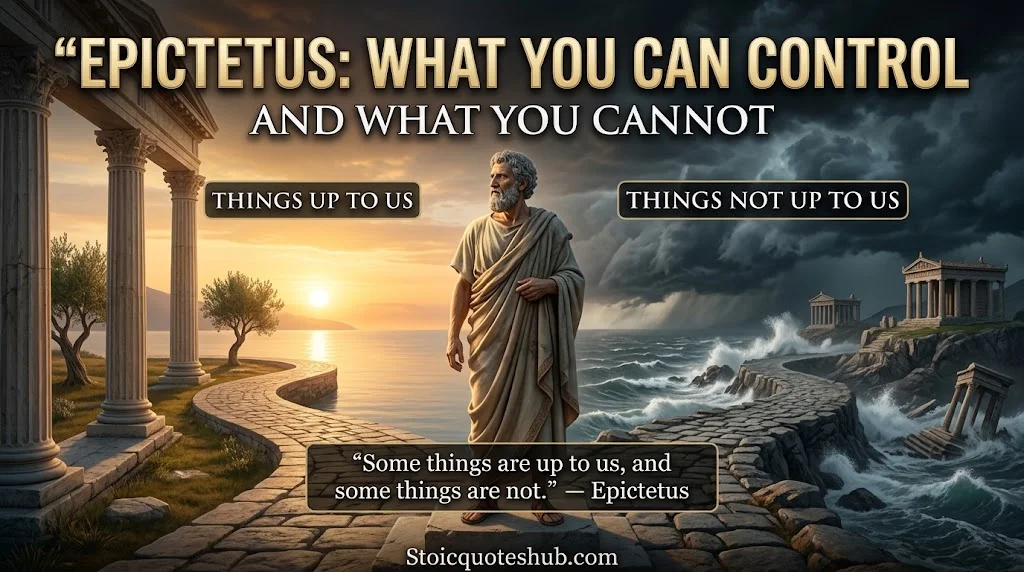
- “First say to yourself what you would be; and then do what you have to do.” (Discourses 3.23)
- “Make the best use of what is in your power, and take the rest as it happens.” (Discourses 1.1)
- “It is not he who reviles or strikes you who insults you, but your opinion that these things are insulting.” (Enchiridion 20)
- “The chief task in life is simply this: to identify and separate matters so that I can say clearly to myself which are externals not under my control, and which have to do with the choices I actually control.” (Discourses 2.5)
- “Difficulties are things that show a person what they are.” (Discourses 1.24)
- “No great thing is created suddenly.” (Discourses 1.15)
- “If you want to improve, be content to be thought foolish and stupid.” (Enchiridion 13)
- “Remember that you are an actor in a play, playing a character of the author’s choosing.” (Enchiridion 17)
- “I must die. Must I then die lamenting?” (Discourses 1.1)
- “How long will you wait before you demand the best for yourself?” (Enchiridion 51)
- “A ship should not ride on a single anchor, nor life on a single hope.” (Epictetus)
- “Silence for the most part, or say only what is needful and in few words.” (Enchiridion 33)
- “Know, first, who you are; and then adorn yourself accordingly.” (Discourses 3.23)
Stoic-minded voices
- “Nothing is miserable unless you think it so; and on the contrary, every lot is happy if borne with contentment.” (Boethius, The Consolation of Philosophy)
- “When we are no longer able to change a situation, we are challenged to change ourselves.” (Viktor Frankl, Man’s Search for Meaning)
- “The greatest weapon against stress is our ability to choose one thought over another.” (William James)
- “Nothing can bring you peace but yourself.” (Ralph Waldo Emerson, Self-Reliance)
- “He who knows he has enough is rich.” (Laozi, Tao Te Ching)
- “There is nothing either good or bad, but thinking makes it so.” (Shakespeare, Hamlet)
- “The mind is its own place, and in itself can make a heaven of hell, a hell of heaven.” (John Milton, Paradise Lost)
- “I am the master of my fate, I am the captain of my soul.” (William Ernest Henley, “Invictus”)
- “Do not anticipate trouble, or worry about what may never happen. Keep in the sunlight.” (Benjamin Franklin)
- “Happiness depends more on the inward disposition of mind than on outward circumstances.” (Benjamin Franklin)
Takeaway: Peace comes from sorting your day into two piles: what you control and what you don’t. Spend your energy on the first pile only.
Must Visit: 185+ Powerful Stoic Quotes on Perseverance to Build Unshakable Strength & Never Give Up
Stoic Quotes on Joy, Gratitude & Living in the Present Moment
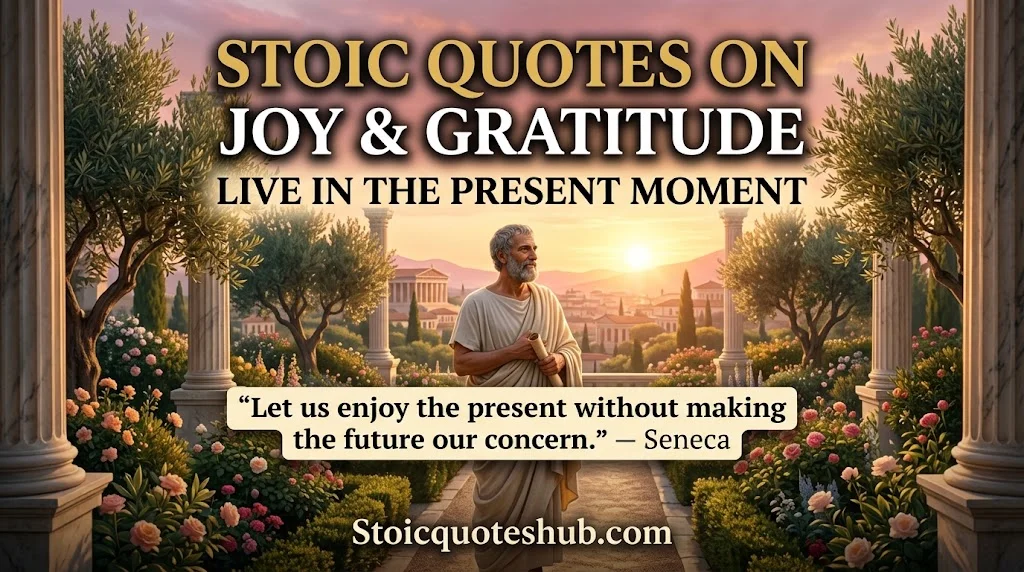
Stoics did not ban joy. They aimed for steady joy that does not depend on luck, status or money. Research agrees on gratitude: Harvard Health reports that giving thanks can make you happier.
Marcus Aurelius on time and purpose
- “Waste no more time arguing about what a good man should be. Be one.” (Meditations 10.16)
- “Soon you will have forgotten everything; soon everything will have forgotten you.” (Meditations 7.21)
- “You could leave life right now. Let that determine what you do and say and think.” (Meditations 2.11)
- “Death, like birth, is a secret of Nature.” (Meditations 4.5)
- “Whatever anyone says or does, I must be an emerald and keep my color.” (Meditations 7.15)
- “I have to go to work, as a human being.” (Meditations 5.1)
- “Do not act as if you were going to live ten thousand years. Death hangs over you. While you live, while it is in your power, be good.” (Meditations 4.17)
- “Everything that exists is in a way the seed of what will be.” (Meditations 4.36)
- “That which is not good for the swarm is not good for the bee.” (Meditations 6.54)
- “Time is a sort of river of passing events, and strong is its current.” (Meditations 4.43)
- “Men exist for the sake of one another. Teach them then or bear with them.” (Meditations 8.59)
- “Ask yourself at every moment, ‘Is this necessary?'” (Meditations 4.24)
- “Begin the morning by saying to yourself, I shall meet with the busybody, the ungrateful, arrogant, deceitful, envious, unsocial.” (Meditations 2.1)
- “Never esteem anything as of advantage to you that will make you break your word or lose your self-respect.” (Meditations 3.7)
- “A man should be upright, not be kept upright.” (Meditations 3.5)
- “Do not be ashamed to be helped; for it is your business to do your duty like a soldier in the assault on a town.” (Meditations 7.7)
- “Do not be disgusted or discouraged if you do not succeed in doing everything by right principles; when you have failed, return again.” (Meditations 5.9)
- “Because a thing seems hard to you, do not think it impossible for anyone to do.” (Meditations 6.19)
Seneca on gratitude and simple living
- “While we are postponing, life speeds by.” (Letters 1)
- “Let us prepare our minds as if we had come to the very end of life. Let us postpone nothing.” (Letters 101)
- “Wherever there is a human being, there is an opportunity for a kindness.” (On the Happy Life 24)
- “He who receives a benefit with gratitude repays the first installment on his debt.” (On Benefits 2.22)
- “It does not matter how many books you have, but how good they are.” (Letters 2)
- “Set aside a certain number of days during which you shall be content with the scantiest and cheapest fare.” (Letters 18)
- “The wise man is self-sufficient.” (Letters 9)
- “If you wish to make Pythocles rich, do not add to his money, but subtract from his desires.” (Letters 21, quoting Epicurus)
- “What you need is a change of soul rather than a change of sky.” (Letters 28)
Epictetus on enjoying what you have
- “He is a wise man who does not grieve for the things which he has not, but rejoices for those which he has.” (Epictetus)
- “When you do something from a clear judgment that it ought to be done, never shrink from being seen doing it.” (Enchiridion 35)
- “Practice yourself, for heaven’s sake, in little things, and thence proceed to greater.” (Discourses 4.1)
- “Only the educated are free.” (Discourses 2.1)
- “It is impossible for a man to learn what he thinks he already knows.” (Discourses 2.17)
- “If you wish to be a writer, write.” (Discourses 2.18)
- “Sickness is an impediment to the body, but not to the will, unless the will itself chooses.” (Enchiridion 9)
Stoic-minded voices on joy and wealth
- “That man is rich whose pleasures are the cheapest.” (Henry David Thoreau, Walden)
- “Happiness is a perfume you cannot pour on others without getting some on yourself.” (Ralph Waldo Emerson)
- “Content makes poor men rich; discontent makes rich men poor.” (Benjamin Franklin, Poor Richard’s Almanack)
- “Be content with what you have; rejoice in the way things are.” (Laozi)
- “Everything can be taken from a man but one thing: the last of the human freedoms, to choose one’s attitude.” (Viktor Frankl)
- “Gratitude is not only the greatest of virtues, but the parent of all the others.” (Cicero, Pro Plancio)
A simple daily practice: Stoics used routines, not willpower. Try this.
- Morning: pick one quote and ask, “What is in my control today?”
- Midday: pause for one breath and name one thing you are thankful for.
- Evening: ask what went well and what you’d do differently, as Seneca did each night.
FAQs
What are the best Stoic quotes on happiness?
Three stand out. Marcus Aurelius: “Very little is needed to make a happy life; it is all within yourself, in your way of thinking.” Seneca: “True happiness is to enjoy the present, without anxious dependence upon the future.” Epictetus: “Seek not that the things which happen should happen as you wish…”
How do Stoics define true happiness?
Stoics define true happiness as eudaimonia, a life of virtue lived in line with reason and nature. The four core virtues are wisdom, courage, temperance and justice. Zeno called it “a good flow of life.”
Can Stoicism help you find lasting happiness?
Yes. Stoicism trains you to focus on what you control, accept what you can’t, and judge events calmly. This builds steady emotional resilience instead of short bursts of pleasure.
What do Marcus Aurelius’ quotes say about happiness?
Marcus taught that happiness lives in your thoughts, not in events. He urged readers to guard their thinking, stay in the present, and act with virtue. Your mind, he said, takes on the color of your thoughts.
What did Seneca say about happiness?
Seneca said happiness means enjoying the present without fear of the future. He warned that we suffer more in imagination than in reality, and that real wealth is having few wants.
Conclusion
Stoic happiness is a skill, not a stroke of luck. Pick one quote from this list, write it down, and try it today. Small daily practice is how ancient wisdom becomes lasting inner peace.

Danish Abroy is a writer and contributor at Stoic Quotes Hub, where he explores timeless ideas from Stoic philosophy and their relevance to modern life. His work focuses on meaningful quotes, practical wisdom, resilience, self-discipline, and developing a calmer perspective in everyday situations.